Yes, a restaurant can sell other brands' ads on the TV it already has. The rule worth copying from McDonald's is about timing: in the pilot of its media network, the third-party ad shows after the order, never during the choice. In a restaurant, arrival and ordering belong to your menu; the wait for the food, the meal and the bill can carry partners. Who buys: local event promoters, real estate agencies, gyms, driving schools, schools. Who never gets in: another restaurant. How to price it is covered in our article on charging advertisers.
If your question is whether to charge a flat fee or a percentage, and how to prove the screen brought customers, start with charging indoor TV advertisers: flat fee or percentage. This article covers something else: when the ad comes in and who buys it, specifically in a restaurant.
What McDonald's did, and what it did not say
On 23 September 2026, at the company's investor day in Chicago, Morgan Flatley, global CMO of McDonald's, presented the McDonald's Media Network: a network that sells ad space to other brands on restaurant screens. The facts confirmed by the three reports below:
| Point | What was said |
|---|---|
| The pilot | Started in August 2026 in 450 company-operated restaurants in the US, about 3% of the roughly 14,000 locations in the country. Franchised restaurants were left out. |
| Where the ad shows | On the digital order boards. The company said the pilot is limited to those boards, with the ad showing after the customer places the order. In the presentation, an insurer's ad took up half of the drive-thru screen. |
| The goal | Flatley called it an "aspiration" to turn the network into a US$ 1 billion business "over time". No year was given. |
| The promise | Revenue "with little in the way of additional cost, no operational complexity, and no disruption to our customer experience", in her words. |
| The market | Flatley said commerce media is expected to exceed US$ 100 billion in the US alone by 2028. It is a projection quoted in the presentation, not audited data. |
Sources: CNBC (Sept 23, 2026), Gizmodo (Sept 25, 2026) and PPC Land, which publishes excerpts from the event transcript. Accessed on October 22, 2026.
What was not disclosed is just as telling: no price list, no list of advertisers, no technology partner and no measurement method. And the pilot only exists where the company runs the store. In other words, the hard part (what to charge and how to prove results) is something not even McDonald's has solved in public. What it made clear is the order: first the order, then the ad.
The order rule: the screen sells your dish first
The promise of "no disruption to our customer experience" is not rhetoric: it is the reason the ad comes after the order. While the guest is choosing, the screen works for the house. Map that onto the moments of a restaurant visit:
| Moment of the visit | Who the screen belongs to |
|---|---|
| Arrival and waiting for a table | You: house dish, daily special, birthday events. |
| Choosing (menu) | 100% you: menu, combos, promotions. No third parties. |
| Waiting for the food | Your drinks and desserts first; partners come in between. |
| The meal | Content that holds attention (news, trivia) with partners in between. |
| The bill | Partners, the review QR code and the invitation to come back. |
While guests choose, the screen does the job of digital menu boards for restaurants and of upselling triggers. After the order, the time left is long, and that time is what you sell. In the episode behind this article, one line sums up the difference: "nobody who goes out to a restaurant at night stays less than an hour". And Mário Sérgio's reply: "you have something McDonald's doesn't: how long people stay".
In practice, this means scheduling by time of day and by position in the playlist: see how to schedule your indoor TV by time of day and the right loop length for the length of a visit in how long should the indoor TV loop be.
The lunch advertiser is not the dinner advertiser
The episode separates the two audiences in one sentence: "the lunch guest is the more formal one, the more formal partnership. The night guest is the one who's out to party". In practice, that means two schedules and two advertiser profiles:
- Lunch: people who work nearby and have to be back on time. A fit for professional services (accountant, clinic, courses), gyms, schools and driving schools.
- Dinner: people out to have fun, often with family or friends. A fit for events, leisure, a partner bar that does not compete with you and real estate agencies. The episode's case for real estate: whoever can afford to dine out is the audience that rents or buys property.
A restaurant open for one shift sells only that profile. One open for both can sell the same screen twice, to different advertisers, because the audience changes.
The advertiser that "never fails": the local event
Among the buyer profiles, the episode highlights one that is usually missing from the lists: the local event promoter. Concerts, parties, rodeos, festivals, fairs. They need to be where the audience is in the weeks before the event, and every month there is an event, including in nearby towns. Three traits make this one of the easiest slots to sell:
- A natural deadline. The slot runs until the event date. No long contract, no renegotiation.
- Built-in renewal. When one event ends, the same promoter (or another) has the next one.
- It replaces what they already do. Promoters already drop flyers on restaurant counters. A spot on the TV swaps paper that ends up in the bin for video shown every loop.
One technical requirement: the spot must be captioned and work without sound, because the dining-room TV is muted. In the episode: "the video has no audio, so it's a captioned video, nicely done". Details in muted indoor TV: your video needs captions.
Who never gets in: the competitor
The rule is simple: no other restaurant. Everyone else, yes. In the episode, Mário Sérgio describes a bar in his town that does exactly this: "he doesn't advertise other restaurants, because of competition, but I've seen ads for a driving school, a gym, private tutoring". Between one partner and the next, the bar itself rotates the daily special, the combo and the invitation to celebrate birthdays there.
This becomes a contract clause: category exclusion, written into the agreement with each advertiser. Before selling, also check whether your franchise, mall or supplier contract restricts third-party ads.
What about the TV showing the game?
It is the most common objection from bars and restaurants with sports on TV. The episode offers two ways out:
- Separate screens. The big screen keeps the game; the TVs around the room keep the menu and partners. Whoever came for the game still has the game.
- Same TV, pause during the match. If there is only one screen, the playlist stops during the match and resumes afterwards. Agree on this with the advertiser: their schedule does not count the minutes of the game.
In Brazil, showing a match or broadcast TV in a commercial venue has copyright implications that have nothing to do with your playlist. Before deciding, read store TVs in Brazil: ECAD and copyright rules.
If you don't do it, someone else will
Some companies offer restaurant owners a TV installed for free: they show ads and keep the revenue (in some models, they pass part of it on to the venue). The episode describes the pitch: "I'll put a TV here, run ads, you give me power, you pay nothing". And the owner's usual answer: "I won't spend anything anyway, let the guy make money".
Take a closer look at that trade. You give up the wall, the power and, above all, the attention of your guest seated at your table; someone else picks the advertisers and collects the money. The model may suit owners who want nothing to do with it, but the alternative is your own screen: with one display, the cost is the entry plan (prices are always up to date in the plans table), the schedule is yours and the slot you sell stays with you. The math for starting with one screen is in indoor TV side income: start with one screen.
A note on the tool: JMV Indoor schedules and displays the spots you upload. It does not sell ads for you, does not auction space and does not measure sales per ad. And no plan, not even the free trial, shows JMV ads on your TV: whether to run third-party ads is your call.
How to prove results to the advertiser
The advertiser who renews is the one who sees a return. A QR code with its own landing page, a coupon exclusive to your venue, a dedicated phone number and "say you saw it on TV and get a gift" are the ways, detailed in charging indoor TV advertisers: flat fee or percentage. In restaurants with long table times, such as pizzerias and all-you-can-eat steakhouses, the QR code is more likely to be scanned, because guests have time to reach for their phones.
The episode behind this article
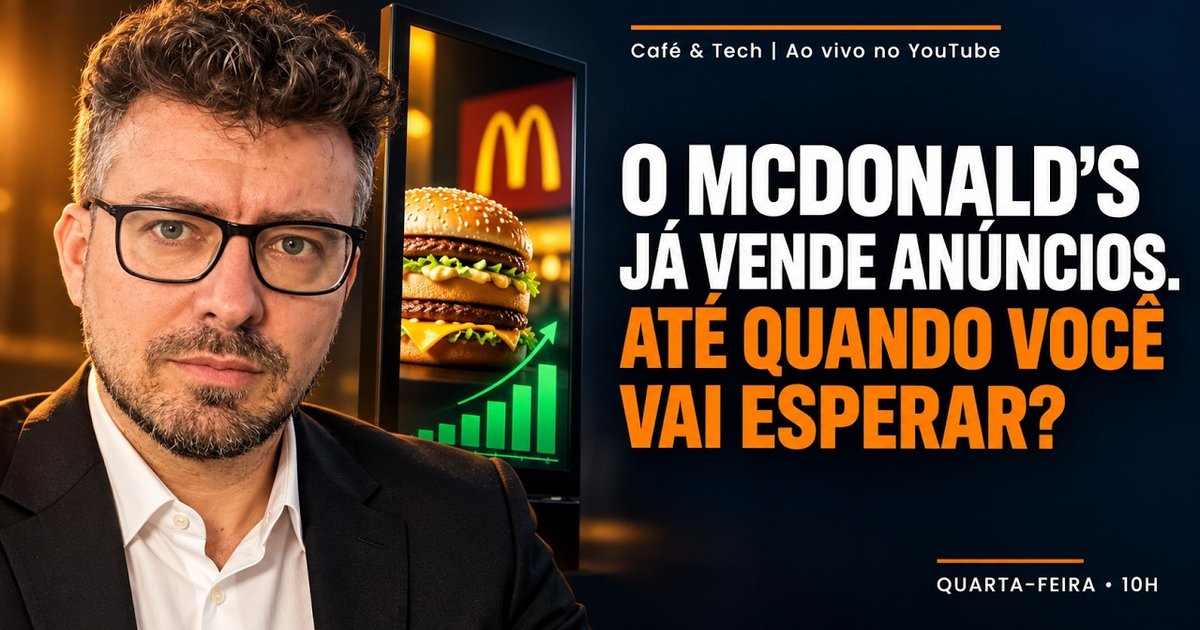
The topic was discussed on Café & Tech on October 21, 2026 (in Portuguese), with Josimar Machado and Mário Sérgio of JMV Technology. The episode is 55 minutes long and covers more than this article; only the restaurant segments are here. Watch the full episode on YouTube.
Episode excerpts used in this article (translated from Portuguese)
Translated from the corrected auto-captions; timestamps are approximate. Values mentioned in the episode are the hosts' examples, not market prices. In the episode the McDonald's pilot is called a "kiosk"; the reports confirm the order boards.
"He goes to your place and says: 'it's a restaurant, I'll put a TV here, run ads, you give me power, you pay nothing' […] The restaurant owner says: 'I won't spend anything anyway, let the guy make money'."
(~3min) "The lunch guest is the more formal one, the more formal partnership. The night guest is the one who's out to party."
(~3:40) "Let me give you an example of raising money for indoor TV. Really easy: the town's events. […] The event owner would certainly pay 200, 300, 500 reais to be in the pre-event for one or two months inside your restaurant. […] And every month there's an event in every town." (value = host's example)
"The video has no audio, so it's a captioned video, nicely done."
(~14min) "Nobody who goes out to a restaurant at night stays less than an hour." — "You have something McDonald's doesn't: how long people stay."
(~15min) "He doesn't advertise other restaurants, because of competition, but I've seen ads for a driving school, a gym, private tutoring."
(~17min) "He has the big screen for football and the TVs spread around the place advertising." — "If it's the same TV, it stops during the game."
"It's your choice whether to show third-party ads or not."
In short: copy the order from McDonald's, not the scale. Arrival and choosing belong to your menu; after the order, the long restaurant wait becomes space for non-competing partners, chosen by shift, with the local event promoter as the easiest slot to start with. For the broader concept, Wikipedia has an entry on digital signage. For how we handle data on the blog, see the Privacy Policy.
Frequently asked questions
What is the McDonald's Media Network?
Can a small restaurant sell ads on its TV like McDonald's?
When should a restaurant TV show another company's ad?
What kind of business advertises on a restaurant TV?
Can I advertise another restaurant on my TV?
What happens to the TV showing the game if I run ads?
Try JMV Indoor free for 30 days: instant activation, no credit card, no payment, just social login →