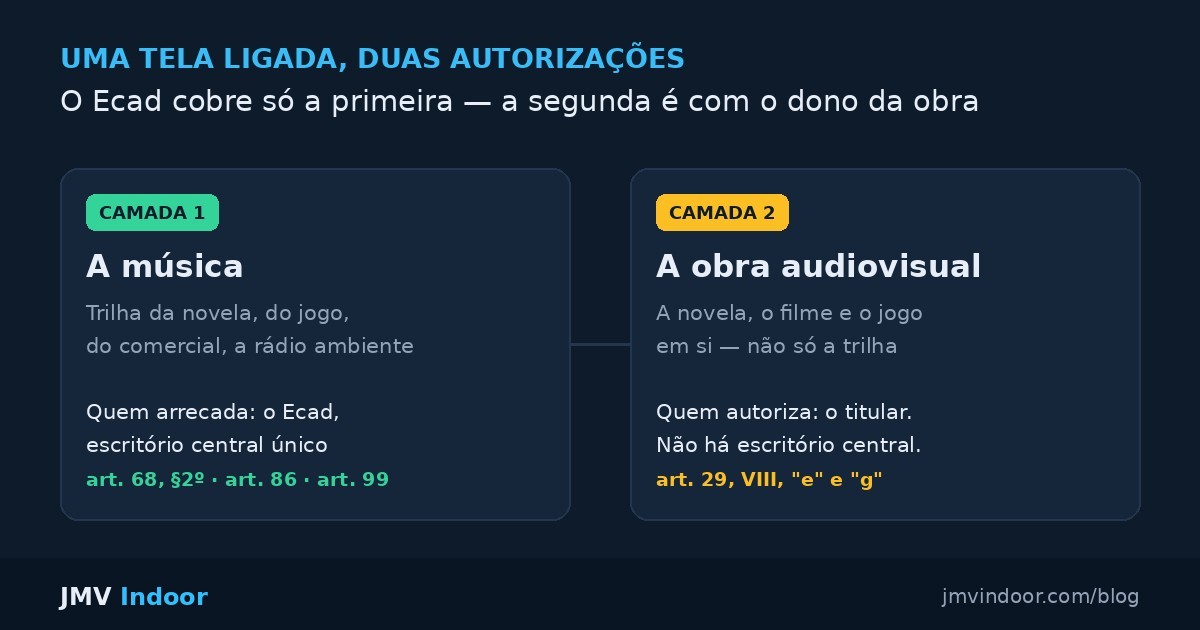
Yes: a TV on in a bar, store or waiting room in Brazil is a public performance and Ecad is due. But Ecad collects one layer only — article 99 of Law 9,610/98 limits the central collecting office to musical and literary-musical works and phonograms. The law puts the audiovisual work inside the same definition of public performance (article 68, § 2) and requires prior, express authorisation for "reception of a broadcast transmission in places of collective attendance" (article 29, VIII, "e"). Those are two authorisations, with different owners: the Ecad receipt settles the soap opera's soundtrack, not the soap opera. A screen running your own content triggers neither.
"Just switch on broadcast TV and let it run": why almost every store does it
The shortcut has an honest explanation, and it is not laziness. Building your own playlist for the screen takes routine work: photographing the product, updating the price, swapping the file. Anyone who depends on a USB stick gives up in week two — which is exactly what we described in the article on how long the indoor TV loop should be and how to size the playlist, and again in the case of the coffee shop that sells through the screen the coffee customers are too shy to ask for. In both, the line from the episode appears verbatim:
"You're not going to take a photo every hour and swap the USB stick every hour. That routine wrecks you. […] That's why so many people just switch on broadcast TV and let it run." Translated from the original Portuguese.
The site described the shortcut twice and never answered the question it opens: is it allowed? That is what this article does. And the answer has two parts, because a switched-on TV takes on two obligations, not one.
What the law calls a "place of collective attendance" (and your store is on the list)
Before discussing who charges what, let us settle the doubt that usually stalls the conversation: "but my store is small, does this apply to me?". It does — and the law leaves no room, because it names the establishments one by one.
There is no size, revenue or intent test. A neighbourhood pharmacy, a clinic waiting room and a 300-seat steakhouse are all on the same list. What the law looks at is the place: a space of collective attendance where a third party's work is transmitted.
It is the same reasoning that makes a screen in a physical venue subject to rules that would never touch the TV in your living room — and that is why a store screen piles up different layers of regulation depending on the segment. In a pharmacy, Anvisa's RDC 96 decides piece by piece what may run at the counter; in a dental practice, the CFO rules govern what the waiting room may show; when someone's face appears, the LGPD and image-use consent come in. Copyright is one more of these layers — and the only one that applies to every segment at once.
The first layer: music. Everyone knows this one
Start with the settled part, the one any search already answers. Music playing in a place of collective attendance is a public performance, and a public performance generates copyright to be paid. Article 68, § 2 defines it broadly: the use of musical or literary-musical compositions, or of phonograms and audiovisual works, in places of collective attendance, "by any process, including broadcasting or transmission by any modality".
Note the "including broadcasting": you do not need to hire a band or build a playlist. A TV on and transmitting is enough — the soap opera soundtrack, the advert jingle, the match's opening theme. And article 86 ties up the end that matters to the shopkeeper: rights over musical works included in audiovisual works are owed "by those responsible for the venues or establishments referred to in article 68, § 3 of this Law, that exhibit them". In other words: the broadcaster having paid does not exempt the bar. They are different triggering events — one on transmission, one on exhibition.
That is collected by the central office under article 99 — Ecad. How much it costs is deliberately out of scope here: the schedule changes and the source is an interested party. If you need the maths, our group already covers it in how much Ecad costs for web radio and web TV (in Portuguese). And if your operation transmits instead of exhibiting — a live show over the internet, say — the problem is a different one, covered in who authorises the broadcast of a live show.
Nothing new so far. The part almost nobody writes starts now.
The second layer: the audiovisual work. Almost nobody collects it — and almost nobody mentions it
Read article 68, § 2 again carefully: it says public performance is the use of phonograms and audiovisual works in a place of collective attendance. The soap opera, the film, the match and the variety show are inside the definition — not only the songs playing inside them.
And article 29 names the shopkeeper's case with almost embarrassing precision. It requires the author's prior and express authorisation for the use of the work, among other modalities, by means of:
f) ambient sound;
g) audiovisual, cinematographic or similar exhibition" Law 9,610/98, article 29, VIII, letters "e", "f" and "g" (free translation) — official Portuguese text at Planalto.
"Reception of a broadcast transmission in places of collective attendance" is, word for word, leaving broadcast TV on in the dining room. It is not a stretched reading or an analogy: it is the scenario the statute describes.
Now the asymmetry — and it explains why you have never heard about this. Article 99, as amended by Law 12,853/2013, defines what the central office collects:
Musical works, literary-musical works and phonograms. The audiovisual work is not on that list. So the account closes like this: the music layer has a central office that charges, audits and issues an invoice; the audiovisual layer depends on authorisation from the rights holder — the broadcaster, the producer, the league, the event organiser — and has no central office at all.
The honest part of this section. The law requires prior authorisation to exhibit a third party's audiovisual work in a place of collective attendance. And, in practice, nobody is currently collecting that from bars with broadcast TV on: there is no central collecting office for audiovisual rights, and this research found no case of a venue being charged for showing a soap opera on free-to-air TV. Both statements are true at the same time. The gap between "the law requires it" and "somebody collects it" is a market fact, not a legal one — and it can close at any moment, because the one who decides to act is the owner of the work, and they tend to decide that when the content starts generating revenue for someone else.
That is usually how the discussion reaches the venue's door: not through a routine inspection, but through the rights holder who noticed the exhibition had become a commercial draw. Which is what happened in the best-known case in Brazilian retail.
The residential plan in the bar: the Premiere case
In an episode of our podcast with lawyer Dr. Euler Manata, a board member of the Minas Gerais Bar Association, published in October 2023, the example appears exactly as the market lived it:
"I think everyone has had the chance to watch football in a bar. Back in the day you'd pay two reais to the bar owner so you could watch Premiere there, and he'd shut the doors so nobody outside could watch. […] What did Premiere do, since it was losing revenue? It opened the Premiere bar licence, specific for bars, to transmit to a collective audience, so to speak. Obviously these were different types of licence. […] That licence cannot be transmitted in a bar." From the episode "Bloqueios da Anatel, o IPTV e as questões Jurídicas" of the Café & Tech Podcast (26 Oct 2023), at 67min35s. Translated from the original Portuguese.
Notice what this proves, and what it does not. It is not a legal thesis: it is a market observation. The rights holder built a separate product for commercial venues precisely because collective exhibition is a different thing — different contract, different price, different scope. When the owner of the work structures a bar licence, it is saying in commercial language what article 29, VIII says in legal language.
The practical consequence is direct: the residential subscription was not sold for the shop floor. That applies to pay TV, to the football package and to the streaming service you subscribe to at home — their terms of use restrict public exhibition, which is why the commercial version exists. Running your home plan on the bar's screen is, at the very least, a breach of contract with whoever sold you the service; and it does not supply the rights holder's authorisation.
For anyone building a video operation with third-party content, the full licensing chain (who signs what, in what order, and what to audit in the supplier) is broken down in how to run a legal IPTV service: licences and contracts, which came from this same episode. The criminal side — what the law punishes, link by link — is in is pirate IPTV a crime? (both in Portuguese). Those two look at whoever distributes video; this article looks at whoever exhibits it on a screen in a physical venue.
The single exception the law opened: the store that sells TVs
There is one scenario in which a TV on in a commercial establishment does not infringe copyright — and it is so narrow that it mostly confirms the rule:
Two cumulative requirements: the purpose must be demonstrating the device and the establishment must sell the device. The appliance store with twenty televisions showing the same scene is covered. The bar that switches the TV on so customers stay longer at the table is not — and the law opened no other door for retail. Anyone arguing "it's just the free-to-air signal, I'm not doing anything" is proposing an exception article 46 does not contain.
What you cannot do to the customer
There is one practice where the consensus is far firmer than in everything above: charging the customer for the exhibition. Industry bodies and consumer protection authorities treat an admission fee or a "screen fee" to watch the match as an abusive practice, and the guidance is repeated before every major tournament. Abrasel, for instance, advises that bars and restaurants should not charge admission to show matches, and reminds venues that promotions tied to the broadcast also fall under the licensing radar.
It is worth stating what this is and is not: it is the institutional position of those bodies, not a statutory provision this article has verified. But there is a practical reason to take it seriously regardless of the legal merits: the moment the venue charges for the exhibition, it stops "having the TV on" and starts commercially exploiting a third party's content — which is exactly the conduct rights holders licence separately, when they licence at all. If the plan is to make money from the match, make it on consumption: a combo, a special menu, a table booking. Not on a ticket.
The maths nobody does: your own content has neither layer
Now put the pieces together. Broadcast TV on in the dining room looked like the free option because nobody issues an invoice for it. But it is the option that carries two authorisations — one already being charged, and one the law requires and the market has yet to collect. The alternative that looked like hard work is the one with no exposure at all.
| What is on the screen | Music layer (Ecad) | Audiovisual layer (rights holder) |
|---|---|---|
| Broadcast TV on in the venue | Due — soundtrack, jingle, theme | Authorisation required by art. 29, VIII, "e" |
| Residential pay-TV or streaming plan | Due | Required — and the operator's contract usually forbids it |
| Own playlist, muted screen | Not applicable | Not applicable |
| Own playlist with third-party soundtrack | Due — the music weighs again | Not applicable |
The last row is the honest caveat, and it kills the lazy reading that "own content exempts you from everything". It does not: if your corporate video carries a third-party soundtrack, or if background radio plays next to the screen, the music layer exists and Ecad is due because of it — regardless of what is on the screen. What own content removes is the second layer, which is the one nobody knows how to measure.
If the problem is having something to run without depending on the free-to-air signal, there is a middle path: a screen with automatic news from partner outlets keeps the playlist alive without anyone updating files every day — and in that arrangement the content arrives licensed through the integration itself, rather than captured from the air.
A screen running your own playlist — prices, offers, notices, corporate content — neither receives a broadcast transmission nor exhibits a third party's work. That is what JMV Indoor does: a playlist scheduled from the cloud, on an ordinary smart TV, with no USB stick and no dependence on whatever the broadcaster decided to air at three in the afternoon.
Checklist: what to document before switching the screen on
If you are going to show content that is not yours — the supplier's video, the partner brand's piece, the manufacturer's clip — the practical part is always the same, and the episode sums it up well. First, find the right person:
"Today's golden tip is this: if you want to licence something, go to the owner of the cattle — that is, go to the owner of the channel, the owner of the work." From the same episode (26 Oct 2023), at 46min30s. Translated from the original Portuguese.
Then turn the "sure, go ahead" into paper — with a term:
"Then the person changes their mind, they don't want it any more, they started making money from it, and they sue you. […] If you don't have a document, it's very hard. […] Whenever you use third-party images it's important to have a declaration […] and the term matters […] state how long that exhibition lasts: one year, ten years, lifetime." From the same episode (26 Oct 2023), from 63min20s. Translated from the original Portuguese.
In practice, for every piece entering your playlist:
- Identify the rights holder — who owns the work, not who sent you the file. The supplier passing it along is not always the one who can authorise it.
- Get the authorisation in writing, even if it is a short signed statement. A verbal agreement does not survive a change of management on the other side.
- State the exhibition term in the document: one year, two, indefinite. With no term, you cannot tell when the authorisation expired.
- Define where the piece will run: one store, the whole network, the mall screens. An open scope is an invitation to disagreement.
- Store it with the piece. The authorisation has to be findable next to the file that is on air, not in the inbox of someone who has left the company.
- Treat music separately. Permission to use the video is not a licence for its soundtrack to be publicly performed in your venue.
This article is not legal advice. It points to the provisions of Law 9,610/98 and shows how they fit a screen in a physical venue, with the official text linked so you can check. A specific case — a particular contract, a penalty, a notice received — is a conversation with a lawyer.
Frequently asked questions
When do I not have to pay Ecad?
When is Ecad due?
Who pays Ecad — the hiring party or the supplier?
Can a bar charge admission to show the match?
Does paying Ecad authorise me to show the soap opera and the film?
Can I use my streaming subscription or residential pay-TV plan in the store?
My store sells televisions and I switch one on to show the picture. Do I need authorisation?
If I only show my own content on the screen, do I still have any obligation?
The passages from the episode, in full
The passages below come from the episode "Bloqueios da Anatel, o IPTV e as questões Jurídicas — Ep 03" of the Café & Tech Podcast, published on 26 October 2023, with Josimar Machado, Mário Sérgio and lawyer Dr. Euler Manata, a board member of the Minas Gerais Bar Association. Automatic transcript, cleaned and punctuated, with no content cut, translated from the original Portuguese.
What comes from the episode and what is this article's own research. The episode deals with content licensing, documentation and collective exhibition. It does not discuss Ecad or public performance — neither term appears anywhere in the conversation. All the legal basis cited above (articles 29, 46, 68, 86 and 99 of Law 9,610/98) is this article's own research, checked against the official text at Planalto, and is not attributed to any of the participants.
Passage 1 — the golden rule of licensing (46min30s)
Passage 2 — written authorisation, with a term (63min20s)
Passage 3 — the Premiere case and the bar licence (67min35s)
The full 1h13min episode, in Portuguese, is on the JMV Technology channel: Bloqueios da Anatel, o IPTV e as questões Jurídicas — Ep 03 | Café & Tech Podcast. The dates and figures mentioned in the conversation are from October 2023 and have not been updated.
In the end, the question in the title has a short answer and a long one. The short one is yes, Ecad is due. The long one is that Ecad is the half of the bill someone organised themselves to collect — and the other half is still there in Law 9,610/98, waiting for the day the owner of the work decides to look at the screen in your venue. A screen running your own playlist has neither. Want to check what your screen can show? Talk to us through the contact form. For the wider picture of the medium, see digital signage.