
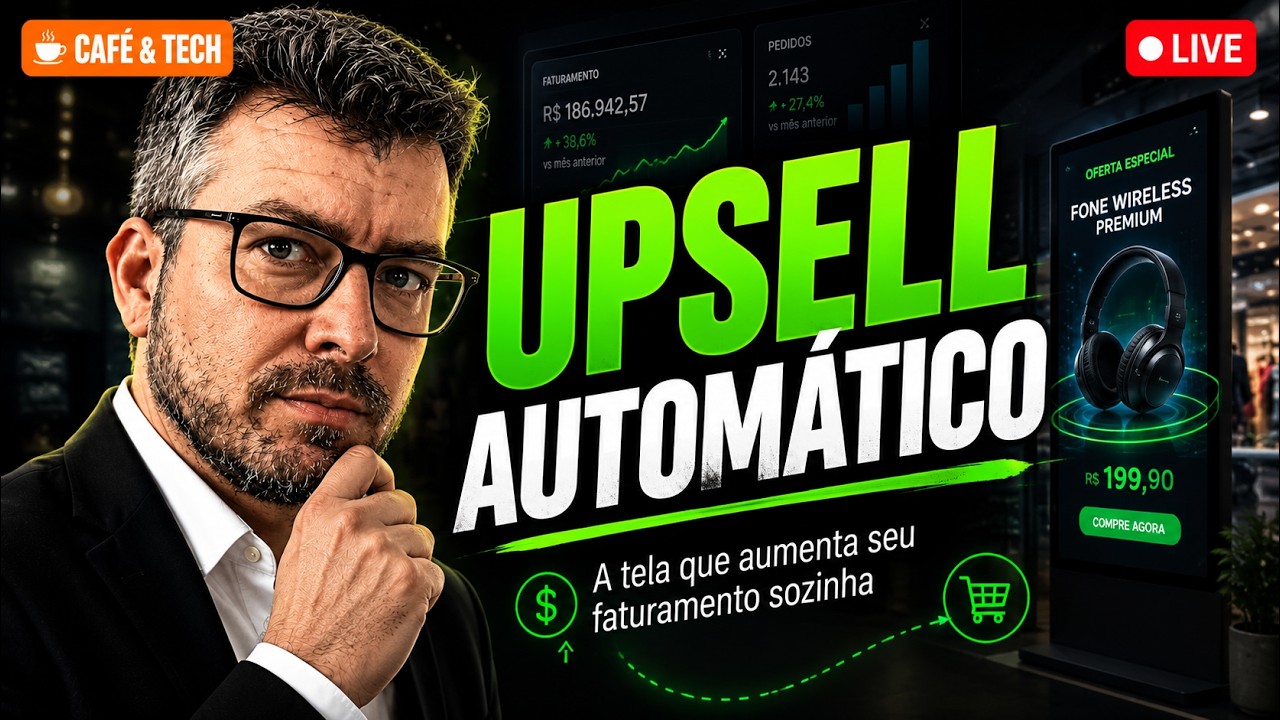
Upselling is the extra sale made to someone who is already buying — a complementary product or service offered at the moment of purchase. It is the cheapest way to grow revenue, because you sell to someone who already trusts the store and has their wallet open. Indoor TV runs this upsell like a "silent salesperson": an ordinary Smart TV, on throughout business hours, shows the right offer in the right aisle, automatically and without being pushy. It works with three triggers — social proof, before-and-after and scarcity — and gets stronger when the content is segmented by department, without depending on a trained salesperson following a script.
What upselling is (and why it is the cheapest sale)
Bringing the customer into the store is the expensive part: marketing, storefront, staff. After the sale, many owners consider the transaction closed — and that is where money is left on the table. Upselling (and its cousin, cross-selling) is the sale on top of the sale: a complementary product or service offered to someone who has already bought and already trusts you. Since there is no cost to acquire a new customer, it is the cheapest way to grow revenue.
The most popular examples come from food: the fast-food combo, the fries and soda that come with the burger, the dessert suggested at checkout in the delivery app, the subscription club with a discount. All of them are upselling — a relevant nudge at the exact moment the purchase is happening.
The golden rule: a real advantage, never a fake one
There is one unbreakable rule: the upsell must be a real advantage. A genuine discount, a product that makes sense together, a better condition for taking the combo. It is not about pushing anything — it is about giving up a slice of margin to create an extra sale the customer perceives as a benefit.
Why human upselling fails in person
Online, upselling works well because it is not intrusive: the "add dessert" button in the app, the popcorn option on the cinema kiosk, the suggestion at e-commerce checkout. Nobody feels pressured. In person, done by a human, it is different — it depends on a trained salesperson following a script, and a clumsy approach ("do you want to take this too?") feels annoying and drives people away.
There are two problems with relying only on the human script: it requires constant training and it breaks exactly at the peaks. On seasonal dates — Father's Day, Black Friday, Christmas — the team is overloaded, and upselling drops right when it was needed most. If the store has fewer people available than the flow demands, the script is not executed and revenue falls short of its potential.
Indoor TV as a silent salesperson
This is where the screen comes in. Indoor TV acts as a silent salesperson: it stays on throughout business hours, loaded with content, catching attention without shouting and without being intrusive. It runs the upsell in the environment where it is already well accepted — the same way the cinema kiosk offers popcorn — but which would feel odd if done by a person holding a "take the fries too" sign.
The screen does not replace the salesperson or human service. It takes over the repetitive, informational part of the extra sale, running constantly and without depending on staffing levels. It is digital signage working in favor of the average ticket, at the point of sale, at the right moment.
Playbook by segment
Upselling is not the same everywhere — it is segmented. A single, generic screen yields little. The gain comes from matching content with the customer standing there at that moment. Here is how that plays out by segment.
Supermarket and pharmacy: by aisle
Because volume is high and you do not know each customer's profile, the content is more general, yet contextual to the aisle. In the coffee section, the screen shows the filter, the sweetener or the sugar on promotion; near the bakery, a frozen-goods tasting. It is the same logic as the guide to Indoor TV by store zone, which details what to show at the checkout, the scale and the shelf.
An important caveat in a pharmacy: this playbook is commercial — it covers what works to sell. When the aisle piece advertises medicine, a second, regulatory ruler applies, and this article does not cover it: health regulation. What may and may not be shown on the counter screen, provision by provision, is in what you can show on a pharmacy TV: medicine advertising at the counter, rule by rule of Brazil's RDC 96. Perfumery, hygiene, dermocosmetics, supplements and store services follow the commercial playbook here without restriction.
Dental clinic: by appointment schedule
Here you can be surgical. From the schedule, the receptionist knows which patient profile will be in the waiting room at each time slot. You program the TV to show the right upsell: someone getting a root canal should not be hit with a whitening offer at that moment; someone in for aesthetics is a strong candidate for a facial harmonization. The screen also educates the patient about procedures, reducing objection from lack of knowledge and easing the receptionist's load.
24h gas station and convenience store
The customer is already physically stopped, waiting to refuel. It is an audience with a high propensity to complete the purchase if the offer is relevant — a coffee, a snack, a convenience item. The screen uses that waiting time to offer the right add-on.
High-ticket procedure clinics
In advanced aesthetics or high-value procedures (in the thousands), the bottleneck is usually the receptionist not keeping up with the flow of educating and selling to the patient. The TV takes over part of that role: it educates about the procedure, shows behind-the-scenes and reduces objection from lack of knowledge, helping convert a ticket that requires building value before the "yes".
Clothing stores: the complete look
In a clothing store, the trigger is the complete look: the screen by the fitting room shows the piece the shopper took into the booth being worn, with the shirt and belt that go with it — the job a mannequin would do if there were room for one per piece. Where to put the screen, what to show and what it may say about store credit and Pix discounts is in Indoor TV for clothing stores.
The 3 sales triggers for your screen content
Within any playbook, three sales triggers work well on screen — as long as they respect the real-advantage rule:
- Social proof. Real testimonials from satisfied customers, Google Business reviews and behind-the-scenes of how the product or procedure is done. This reduces the fear of those who do not know the process. It is the same principle as cross-selling psychology applied at the point of sale.
- Before-and-after. Very effective for aesthetics, whitening and beauty salons. Important caveat: in a health procedure regulated by a professional council, the ruler is held by that council, not by the advertising watchdog — and the rule is usually written law, not a recommendation. In dentistry in Brazil, for instance, the waiting room TV is the clinic's channel and patient before-and-after imagery stays off it; the detail, with the article and the act behind each rule, is in what you can air on a dental office waiting room TV. Advertising self-regulation still applies to general advertising and to sectors without a professional council.
- Scarcity and urgency. "Last days", limited edition, offer of the date. Use the seasonal calendar — Father's Day, Black Friday, Christmas, Mother's Day — as an editorial calendar for the screen.
And the biggest bottleneck of keeping the screen fresh — with no agency or video editor — is solved by generating videos from photos with AI: you photograph the product on promotion, write the caption, and the video shows up on the TV in minutes.
In the three triggers above, what fires the slide is the context you scheduled: the hour, the queue, the spot in the store. There is a variation where the trigger is physical presence detected by a camera, with the screen reacting to whoever stopped in front of the shelf — considerably more complex, and still a project on request, as we explain in indoor TV with a camera and aisle-aware content.
How to get started
JMV Indoor's Indoor TV runs 100% in the cloud, on an ordinary Smart TV connected to the internet — no kiosk, no USB stick, no dedicated box. You program everything from your phone, and plans with more than one screen allow different playlists per aisle or department — exactly what segmented upselling needs. First, make sure the network and device prerequisites are in place so the screen does not freeze or pixelate in the middle of the offer.
| Feature | For upselling |
|---|---|
| 30-day free trial | Validate the idea in your store, with 1 screen and no credit card |
| Additional screens | A distinct playlist per aisle/department — the basis of segmentation |
| AI video | Fresh content from photos, no agency, to keep up with seasonality |
Start with the 30-day free trial — enough to prove the ticket gain in your own store before any decision. Questions about plans and pricing can be handled through our contact page.
Prefer to understand the context first? Watch the full Café & Tech episode on upselling with Indoor TV on YouTube.
See also our Privacy Policy.
A reminder that closes the loop: all of this upsell gain only happens with the screen on. If it goes dark, the opportunity walks out with the customer — see the real cost of leaving the indoor TV turned off. And so every salesperson, including the seasonal hire, offers the right bundle, use the same screen to train retail staff and standardize the information.
In a dental practice the same mechanism becomes treatment education — the segment take is in waiting room TV for dental offices.
Where this playbook does not apply: healthcare premises. The triggers above are for retail. In a medical clinic, urgency, scarcity and social proof go through the filter of article 11 of Brazil's CFM Resolution 2,336/2023 first, which forbids guaranteeing, promising or implying good results (item XII) and any sensationalist or self-promotional tone (item XVI). The full filter is in what can air on an aesthetic clinic TV.
Frequently asked questions
What is upselling and why does it grow revenue?
Does Indoor TV really increase sales?
How does upselling work in a pharmacy or supermarket?
Can I use before-and-after on a clinic's Indoor TV?
Do I need a trained salesperson for upselling to work?
What are the 3 sales triggers to use on Indoor TV?
How much does it cost to start with Indoor TV?
Start JMV Indoor's 30-day free trial →
Related reading: every trigger above raises the ticket of that order — it is product upselling. There is a use of the same screen with a different target: changing where the next order comes in, moving the customer off the marketplace and onto the restaurant's own app. That is channel upselling, and it has different limits — see can I sell cheaper on my own app than on the delivery marketplace and say so inside my store.
Segment deep dive: in a barbershop the client sits facing a mirror for over half an hour, and the booking schedule tells you in advance which service they chose — which changes how these triggers are applied. The full version is in barbershop digital signage: the screen between the mirrors.