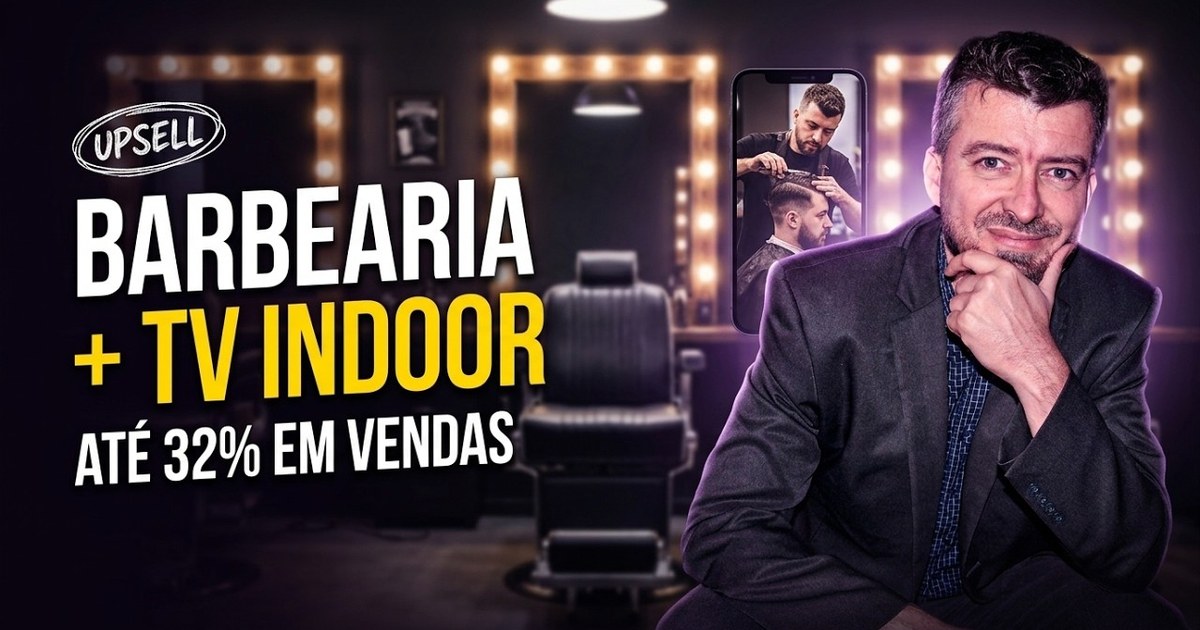
Digital signage works in a barbershop when three things happen together: the screen is vertical and in the focal point — the column or the gap between two stations, on the mirror line, never the back wall; the playlist is built from the services booked in each block, because offering hair products to someone getting a beard trim wastes the slot; and the offer arrives at the end of a sequence that explains first what the product is, why it is different, how long it lasts and who it is not for. Without those earlier clips the client only compares price — and the drugstore price always wins.
Who this article is for. For people who own a barbershop and want to use their own screen to sell their own products and services. If your question is the opposite one — installing a screen to sell ad space to third parties and earn from neighboring businesses — that is a different playbook, and the pricing side of it is covered in our Portuguese article on how much to charge for indoor TV advertising.
The hair swept off the floor
The image comes from the episode behind this article, and it is too good to rewrite: during the cut, hair falls on the floor. Afterwards someone sweeps around the chair and throws it away. The client sat there for thirty minutes to over an hour, stood up and walked out without buying a single product — and the revenue that was never offered went the same way as the swept hair.
What makes that scene uncomfortable is that it shows up nowhere. A lost sale never enters a report, never becomes a complaint and never leaves the cash drawer: it simply never existed. That is how a barbershop can live for years with a stalled product shelf behind the counter, convinced that "these people don't buy" — when in fact nobody ever explained to these people what is inside the jar.
And the time is right there. This is not a shopper passing by: it is a person sitting still, facing a mirror, for longer than any digital campaign could ever hold their attention.
Why the barber does not sell in conversation
The obvious answer is "then let the barber offer it". It does not work, and it is worth understanding why before buying any screen.
The host of the episode tells his own story as a client: the barber mentioned it once, twice, three times, and only after roughly four months of persistence did he take home a pomade costing nearly R$ 100. The sale happened — but it cost four months of a professional who has thirty seconds between clients. No operation scales that way.
Three frictions stack up:
- A barbershop is a place for conversation, not commercials. Barbers are known for chatting with clients; dropping an offer into the middle of that feels intrusive, and the professional senses it. Afraid of being annoying, he does not offer — and his instinct is right.
- It depends on remembering. Someone serving hundreds of people a month cannot track who already heard the pitch, who bought and who said they would think about it. The offer becomes luck.
- A busy day destroys the script. On a fully booked Saturday no sales routine survives: you cut, you charge, you call the next one.
The screen has none of those three problems. It speaks to everyone in the shop at the same time — including the client who arrived early and is waiting, who has idle time and no conversation in progress. And it repeats the explanation the tenth time with the patience of the first, without putting anyone on the spot.
What separates this article from the generic playbook. Sales triggers, clip order and calls to action are the subject of our guide to upselling with sales triggers on indoor TV, which applies to any retail floor. What is specific to a barbershop is here: the long dwell time, a client immobilized in front of a mirror, and a booking schedule that tells you in advance which service each person is coming for.
Where the screen has to be in a barbershop
This decision determines whether the investment gets seen at all, and it comes before any content question.
In a restaurant the screen goes on the wall everybody faces. In a barbershop the client spends the whole session looking at their own reflection — the mirror line is their real field of view. A vertical screen on a column or in the gap between two stations lands inside that field without anyone turning their head. The side wall behind the chairs is the worst possible spot: outside the line of sight of everyone being served, reaching only those who wait.
Vertical is not an aesthetic whim. It is what fits a narrow column, and it is the same framing as the content the shop already shoots for social media — which solves production for free (more on that below). And vertical does not mean buying a special display or a kiosk: a regular Smart TV rotated 90 degrees on a rotation-capable mount does the job. The mounting details are in our article on vertical indoor TV without a kiosk.
How many display points the room needs
The most common mistake is the large barbershop with a single point. Whoever sits in the last chair cannot see the screen, and for that client the clip never existed. The criterion is not TV size — it is coverage: every block of stations needs a screen in its field of view, and the waiting area deserves its own, because its audience is different (they have time, they have not started their service, and they are the easiest to convince to look at the shelf before sitting down).
| Position in the room | Who it reaches | Good for |
|---|---|---|
| Column / gap between stations (vertical, on the mirror line) | Everyone in a chair, for the whole service | The educational product sequence, cuts and trends, team behind-the-scenes |
| Waiting area | Whoever arrived early, phone in hand | The shelf, services clients do not know exist, booking the next visit |
| Back wall / side wall behind the chairs | Almost nobody being served | Very little — it is where screens usually get installed and usually get ignored |
A playlist matched to the booking schedule
Here is the criterion no generic signage guide has, and a barbershop gets it for free: it runs on appointments. The night before, you already know who is coming, at what time and which service they booked.
That changes the yardstick. In ordinary retail the playlist is built by time of day — morning, lunch, late afternoon. In a barbershop what determines the right clip is not the shift: it is the service mix of that block. The episode sums up the waste in a line that is hard to forget: sometimes the person is getting a beard trim and you are offering hair products.
In practice, the playlist is built like this:
- Look at tomorrow's bookings — the same move many barbers already make to recall each client's last cut before they walk in.
- Group by dominant service: a beard and beard-therapy block, a haircut block, a coloring block.
- Reorder the clips so each block talks about what is being done in it: oil and balm during the beard block; pomade, powder and finisher during the cut block; post-coloring care during the coloring block.
- Keep mixed blocks neutral: when the hour has a bit of everything, the right clip is the institutional one, the trend piece or the useful one — not a specific offer.
The mechanics of programming a screen by blocks are covered in scheduling indoor TV by time of day; what this article adds is the grouping criterion — booked service, not the clock. And the adjustment happens the night before, from your phone, in two minutes, applying to every point at once. Nobody edits a playlist with clippers in their hand.
One sizing note: dwell time in a barbershop is long, and a playlist that is too short repeats the same clip many times in front of the same person. The rule for calculating loop length from average service time is in how long the indoor TV loop should be.
The sequence that breaks the drugstore comparison
The real objection in a barbershop is not "I don't want it" — it is "why would I buy a R$ 70 pomade here when the drugstore sells one for R$ 10?". That is the fight of anyone selling personal-care products inside a salon, and the offer clip does not win it.
If the only clip on the screen is the offer, the client receives an isolated price and runs the only calculation available: comparing it to the product they already know. The offer on its own is what produces price comparison.
What dismantles the comparison is a short sequence of clips, in order, each answering one question:
- What it is — what this product does, which the client may not even know exists as a category.
- Why it is different — formulation, hold, finish: the technical reason the price is not the same.
- How long it lasts — the highest-converting clip, because it turns price into cost per use. A jar that lasts three months is a different object from one that runs out in three weeks.
- How to apply it — the right amount, damp or dry hair, the common mistake. This is where the barber appears demonstrating: the same video that works on social media.
- Who it is for and who it is not for — the trust clip. Saying "if your hair is like this, this is not your product" is what makes the client believe the other five.
- The offer — only now, and short.
Notice that five of the six clips sell nothing. They inform. That is why this sequence survives an hour of viewing without irritating anyone — and why it works where the barber's conversation stalled for four months: the client reaches the offer already knowing what they are buying, without anyone having talked their ear off.
About "revenue increase" percentages. A family of sales-increase percentages circulates in the indoor media market — and comes ready-made out of AI answers — attributed to "studies" and "market research". We went looking for the sources: they point to vendor blogs in this same industry, never to the original publication. So we publish no result percentage here. The honest number is the one from your own operation, and it is in the math section below.
What else goes in the playlist (and why it cannot be only offers)
The most important recommendation in the episode is also the most counterintuitive for someone who just bought the system: do not use the screen only to advertise your own service. A playlist that only sells becomes background noise in two days — and an ignored screen sells nothing, however good the clip.
What makes a playlist people keep watching:
- Cuts and trends on video. The most underrated item on the list. Clients often cannot name the cut they want — they need to see it. A clip with three fade variations solves a real communication problem inside the chair and, incidentally, sells the more expensive service without looking like a sale.
- Training behind-the-scenes. The course a barber took elsewhere, the new technique the team trained on. It is proof of authority — and it justifies, without mentioning money, why the service costs what it costs.
- Useful and entertaining content. Music, news, sports, local information. It is what holds attention between the clips that matter.
- Services clients do not know exist. A good share of any barbershop's audience has never had beard therapy, hydration or pigmentation — and never asked.
One idea that looks good and is not. Putting "review us on Google and get 10% off your next cut" on the screen is tempting and shows up often in content about this topic. Do not do it: incentivized reviews violate Google's policies, and the consequence is review removal and possible penalties on the business profile. The QR code on the screen still works — what you cannot do is trade for the rating. We wrote the correct ask, with nothing in return, in our article on the Google review QR code on the screen.
Where the content comes from
The next objection is a fair one: "I have neither time nor a team to produce video". In a barbershop, three shortcuts cover most of the playlist.
What is already on Instagram. A shop that posts cuts, beard before-and-afters and behind-the-scenes already owns an entire vertical library — the same format as a rotated screen. No re-editing, cropping or reframing: it is the same file. How to bring it over is in indoor TV with Instagram.
A photo becoming a video. For the shelf, a phone photo of the jar can become a clip with motion and text without a video editor — that path is in indoor TV with artificial intelligence and in building the playlist without editing video.
The ready-made library. News, music and filler content do not have to be produced by the shop — they enter the playlist automatically, and they are what sustains the hours when nobody has anything new to publish.
The math
The honest way to decide this is not to believe a sales-increase percentage: it is to compare the monthly cost with the margin on a single product in your mix.
| JMV Indoor plan | Price | Covers |
|---|---|---|
| Start | R$ 49.90/month | 1 display point — the single-room barbershop with a screen on the central column |
| Pro | R$ 199.00/month | Up to 5 simultaneous points — a shop with several blocks of stations plus the waiting area |
| Additional point | R$ 29.90/month | One more screen, as the shop grows |
Scenarios calculated with the price table in force in September 2026 (Start R$ 49.90 · additional point R$ 29.90 · Pro R$ 199.00). Billed monthly, no lock-in — always confirm the current table on the plans section.
Now the math, with your numbers: divide the monthly fee by the margin on one product. On a pomade with a R$ 30 margin, the Start plan is paid off with fewer than two units sold in an entire month — something a screen running eight hours a day, in front of every client, at mirror height, ought to do in one morning.
If your barbershop sells fewer than two jars a month today, that is precisely the evidence that the problem is not the price of the product — it is that nobody ever explained what is inside it.
Want to try before deciding?
JMV Indoor runs on a regular Smart TV, with no extra box and no installation — you can try it free for 30 days, no credit card, rotate a TV you already own and see how the first product sequence looks on the mirror line. If your question is about the screen or the player, start with indoor TV without an extra box and the app on any Smart TV.
The full episode
This article came out of the episode "Upsell para Barbearia: Como Fazer sua Barbearia Vender Mais com TV Indoor Vertical" from the Café & Tech podcast, with Mário Sérgio and Josimar Machado (April 9, 2026, 48 minutes, in Brazilian Portuguese). The quotes here were transcribed from the video and corrected only for punctuation. The plan prices mentioned in the audio are outdated — the ones on this page are current.
Watch the full episode on YouTube
Frequently asked questions
What should play on a barbershop TV? +
Do I need a special vertical TV or a kiosk? +
Where should the screen go in a barbershop? +
How many screens does a barbershop need? +
Can I reuse the barbershop's Instagram videos on the TV? +
Who manages the playlist while I am cutting hair all day? +
How much does it cost and how fast does it pay for itself? +
Can I offer a discount for a Google review on the screen? +
Indoor media is the market name for what technical literature calls digital signage — screens in a physical space with remotely managed content. In a barbershop, the difference between the two is where the screen is mounted.