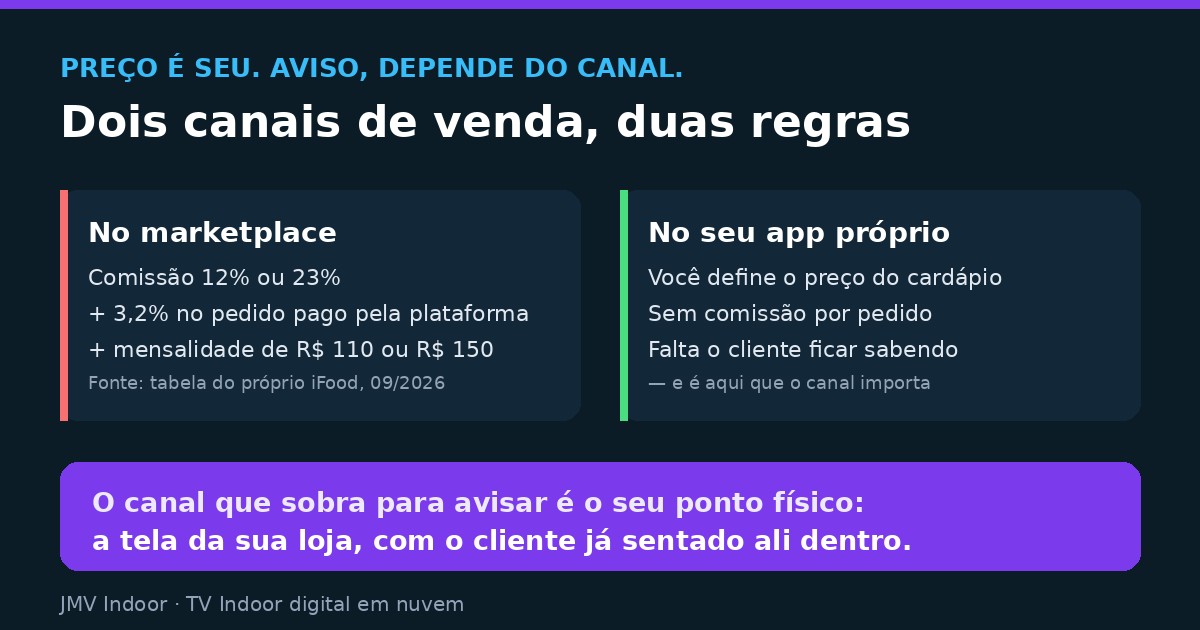
Yes. Menu pricing is your decision, and the same burger is commonly cheaper on your own app — on a marketplace, the order carries a 12% or 23% commission, plus 3.2% when payment goes through the platform, plus a monthly fee. What changes is where you announce it: using the marketplace's own infrastructure (the order chat, the packaging that ships through it) to pull customers away is what gets described as risky. Your physical location is your channel — and the screen in the dining room talks to someone already sitting there. Before anything else, look for the narrow price parity clause in your contract.
The scene: the customer already sitting in your dining room
The conversation behind this article starts with a plain observation from someone who sells burgers: the customer in the dining room is, more often than not, the same person who will order from home next week. They already walked in, already chose, already trust the place. They are the cheapest person in the world to convince, because they do not need to be discovered — they are three metres from the screen.
"If you have a repeat customer inside your burger restaurant, that person already trusts your business, already buys from you […] you market your own delivery app or your own website […] you show today's promotion on the TV: download our app." Excerpt from the Café & Tech Podcast episode cited at the end of this article (originally in Portuguese).
The idea is straightforward, and that is where the doubt that paralyses operators shows up: am I allowed to? They heard the platform forbids it, they heard it does not, they saw a social media clip saying one thing and the platform's own blog saying another. This article separates what can be stated with a source from what cannot — and goes no further than that.
The math operators skip: commission has three components
Before discussing what may be said, it helps to size the problem correctly. Almost everyone talks about commission in the singular: "they charge 12%", "they charge 23%". The rate card published by iFood, Brazil's largest food delivery marketplace, on its own page about selling on the platform, has three components.
| Plan | Commission | Fee on orders paid through the platform | Monthly fee |
|---|---|---|---|
| Básico | 12% | 3.2% | R$ 110/month |
| Entrega | 23% | 3.2% | R$ 150/month |
On both plans, the monthly fee applies to partners billing more than R$ 1,800 a month. Figures checked on iFood's own page about selling on the platform on September 24, 2026 — rate cards change, and they differ by country, so check yours before doing the math.
What this changes in practice: on an order paid through the platform, the percentages add up to 15.2% on Básico and 26.2% on Entrega — and the monthly fee sits on top, regardless of order volume. That is not the same as "12% to 23%", which is how the math usually gets summarised. Note what this article is not saying: it is not telling you how much you would save by migrating customers. That depends on your margin, your ticket and how many orders come through each channel. What is stated here is only the cost structure, with the source linked above.
Price and announcement are two different things
Here is the confusion that leaves money on the table. Operators merge two questions into one and conclude that "everything is forbidden". They are two:
- How much do I charge on each channel? Menu pricing is the restaurant's decision. Prices inside the marketplace are commonly higher precisely to absorb the commission in the table above.
- Which channel do I announce it on? This is where it changes, because the announcement can happen on a channel that is yours (the dining room, your social media, your own messaging) or on a channel that belongs to the platform (the order chat, the packaging that shipped through it, the customer contacts obtained there).
That is how the internet answers this today. Google's AI summary, consulted on September 24, 2026 for this exact question, replied that a restaurant may sell cheaper on its own app but should not use the platform, its chat or its packages to tell the customer about it — and listed the recommended route as the physical traffic of the restaurant itself: kiosks, counter signs and a QR code on the table.
An honest caveat, and it matters. That answer rests, among other sources, on social media videos and on the platform's own blog. We did not read iFood's contract — the public terms pages did not respond to access attempts on 2026-09-24. So this article does not claim what the contract permits or forbids, and cites no clause number at all. What is written here is: this is what the platform communicates publicly and what circulates among operators. The final word on your case is in the document you signed — and the next section gives you the exact thing to look for in it.
The name of the clause: narrow price parity (narrow MFN)
This is the part that rarely reaches restaurant owners, and it is the most useful: the type of clause that prevents you from charging less on your own channel has a name, and that name is used by competition authorities around the world. Knowing it is what lets you find the clause in your contract.
Cade — Brazil's competition authority — published Working Paper No. 03/2026 on July 1, 2026, a 110-page study on competition challenges in the food delivery market. The definition is literal (translated from the Portuguese original):
And the study's general assessment: "imposing parity (wide or even narrow) tends to align prices with the most expensive channel, neutralising competition between platforms through lower commissions and discouraging investment in direct channels."
The study documents cases across several jurisdictions. The table below is the summary — and the last row matters as much as the others:
| Jurisdiction | Platform | Outcome |
|---|---|---|
| Finland (FCCA) | Wolt (DoorDash group) | Narrow parity over direct channels; the company ended the clauses and commitments were accepted |
| South Africa (CompCom) | Uber Eats, Mr D Food | Removal of wide parity clauses ordered; monitored until 2025 |
| Hong Kong (HKCC) | Keeta | Commitments proposed to remove both narrow and wide parity; decision still pending |
| Sweden (Konkurrensverket) | Foodora | Narrow parity restricted to direct channels alleged; contracts were revised |
| Germany (Bundeskartellamt) | Lieferando (2023) | The exception: the authority concluded the restrictions it assessed did not constitute an infringement |
The honest reading of that table is this: parity is treated as a competition problem in most jurisdictions, not in all of them. Anyone who reads only the first four rows walks away thinking the practice is illegal by definition — and that is not what the study says.
What is official in Brazil, and what cannot be claimed
In Brazil there is an ongoing investigation into delivery platforms' contract clauses. In a decision dated September 2, 2026, Cade's Tribunal ordered the investigation into 99Food's contract clauses to continue, while denying the request for a preventive measure. The same decision instructs that the parameters of a cease-and-desist agreement previously signed between Cade and iFood be taken into account.
What this article will not claim. That such a cease-and-desist agreement exists is in the official announcement above. What it forbids, no — we did not read the document, and Cade's own study cited in the previous section does not describe its contents. We also do not claim that iFood's contract in Brazil does, or does not, contain a parity clause. What we give you is the name of the thing and the authority's definition. Search your signed contract for "parity" and "direct channels"; if you find it, that is a matter for your lawyer, not for a blog post.
What the store screen can actually do
If the remaining channel is the physical location, the question becomes operational: what exactly goes on the screen? Four pieces cover almost everything, and none of them requires a marketing team.
- The app's QR code, big. The customer is seated, phone in hand, with time to spare. It is the only moment in their day when they have the patience to install something. The mechanics are the same ones we covered in the article about the Google review QR code on the restaurant TV — but note that the limit there is a different one: it is a Google rule about not offering a freebie in exchange for the review, and it has nothing to do with delivery marketplaces.
- The app walkthrough, screen-recorded from your own phone. Twenty seconds showing an order being placed, with one line of text on screen. That is almost literally what the episode suggests: record the screen placing the order, upload the clip to the indoor TV system, and caption it "see how easy it is to order from our app".
- The direct-channel price. If the app is cheaper, the number can be shown. But displaying a price on a screen has a legal consequence almost nobody considers — that is the next section, and it comes before the sales pitch on purpose.
- The loyalty programme. The screen is where a repeat customer finds out there is an advantage to ordering through your channel. The digital menu board, which we covered in detail in the article on digital menu boards for restaurants, can carry that message alongside the combos.
Notice what this is, in retail language: a channel upsell, not a product upsell. The classic playbook — suggest the dessert, upgrade the combo, sell the add-on — is in the article on indoor TV upselling and sales triggers, and there the goal is to raise the ticket of that order. Here the goal is different: to change where the next order comes in. Same screen, different trigger.
And there is a warning from the episode worth repeating, because it is not about any specific marketplace:
"Be careful about building your business on top of somebody else's business. […] They can change the rules whenever they want, charge whatever fee they want, and there is absolutely nothing you can do about it." Excerpt from the same episode. The reasoning applies to any third-party platform, software included.
Our own limit is worth stating too: JMV does not build and does not recommend delivery apps for restaurants. This article does not teach you to build an app, does not recommend a platform and promises no savings — it is about the communication channel inside the store, which is what we actually deliver.
The limit that comes before the sale: a displayed price binds you
Read this before putting a price in the playlist. A price shown on the store screen binds the store, exactly like a paper sign: Brazil's Consumer Protection Code treats sufficiently precise advertising information as part of the contract (article 30) and guarantees the consumer the right to demand the offer be honoured as advertised (article 35, I). If the screen says "R$ 30 on our app" and the promotion ended yesterday, that is your problem. We covered that responsibility in detail, with the articles and the cases, in price on the store screen: what your store takes on when it swaps a paper sign for a TV — read it before displaying any figure.
The practical consequence is simple: whoever displays prices needs to be able to take them down in minutes. A screen fed by a USB stick does not do that — the expired promotion keeps looping until somebody remembers to swap the file. That is the difference between a managed screen and a screen that is merely switched on.
The burger-restaurant window: about 60 minutes
There is a figure in the episode that changes how you design the playlist, and it is specific to this segment. A burger-restaurant customer waits about 15 to 20 minutes for the order and then spends roughly another 20 minutes eating. Adding arrival and departure, that is around 60 minutes of captive attention: seated, unhurried, phone in hand.
That is a lot of time for a screen — and far too much for a short loop, which starts repeating and turns into wallpaper. The rule of thumb for sizing the playlist to customer dwell time is in the article on how long the indoor TV loop should be; the roughly 60-minute burger-restaurant window is one more case for that calculation. In practice, it works to split content by moment: in the first minutes, combos and add-ons (the order is not closed yet); later, while the person eats, the app QR code and the walkthrough — once they have tasted the product and are more likely to install it.
How to start without buying hardware
The barrier here is usually not technical; it is the assumption that you need a kiosk, a panel and an installation crew. You do not. The screen that matters is the ordinary Smart TV many restaurants already have on the wall — JMV Indoor is 100% cloud-based, runs in landscape or portrait with no additional hardware, and the schedule is managed over the internet.
In practice: you upload your app's QR code and walkthrough, build the playlist for each part of the day, and swap the promotion from your phone when it ends — the step-by-step is in how to manage indoor TV from your phone. You can try it free for 30 days before deciding, and current plan prices are always up to date in the plans table on our site.
Frequently asked questions
Can I charge less on my own app than on the delivery marketplace?
Can I tell customers inside my store that my own app is cheaper?
Can I put a flyer inside the marketplace order packaging?
What is a price parity clause (narrow MFN) and why does it matter to me?
How much does a delivery marketplace actually charge?
If I put my app's price on the TV, am I bound by that price?
Do I need an expensive kiosk or video wall for this?
What happens if I sell less than R$ 1,800 on the marketplace?
Which app replaces the delivery marketplace?
What is most profitable to sell on a delivery marketplace?
Which app sells food cheaper?
The episode excerpts, in full
The excerpts below come from the episode "Indoor TV for Burger Restaurants: How to Multiply Combos and Sell More at the Counter", from the Café & Tech Podcast, published on September 23, 2026, with Mário Sérgio, solutions consultant at JMV, and Josimar Machado. Automatic transcription, cleaned and punctuated, translated from the Portuguese original with no content cut.
What comes from the episode and what is this article's own research. The episode is about on-screen content, moving customers to the direct channel and playlist routine. It does not mention Cade, price parity, narrow MFN or the Consumer Protection Code — none of those terms appear anywhere in the conversation. All the legal and competition material in this article is our own research, checked against the sources linked above, and is not attributed to any of the participants. The remark that "the marketplace's rules do not allow" the announcement inside the platform is a claim by the host, not a reading of the contract — see the caveat in the section "Price and announcement are two different things".
Excerpt 1 — the repeat customer already inside the store
Excerpt 2 — different prices per channel, and where the announcement happens
(A claim by the host; not a reading of the contract — see the caveat in the body of this article.)
Excerpt 3 — the QR code on the screen, for someone already seated
Excerpt 4 — the walkthrough recorded from the phone screen
Excerpt 5 — the window of roughly 60 minutes
Excerpt 6 — the warning about depending on someone else's business
The full 1h22min episode is on the JMV Technology channel, in Portuguese: Indoor TV for Burger Restaurants: How to Multiply Combos and Sell More at the Counter — Café & Tech. The figures quoted in the conversation are from September 2026 and have not been updated.
In the end, the title's question fits in two sentences. The price is yours: you can charge less on your own channel, and the three-component table explains why the difference exists. The announcement depends on where you make it — and the only place where the rules are entirely yours is the square metre inside your own store, with the customer seated, waiting for the burger. Want to see how your screen would look with your app's QR code on it? Talk to us through the contact form.