
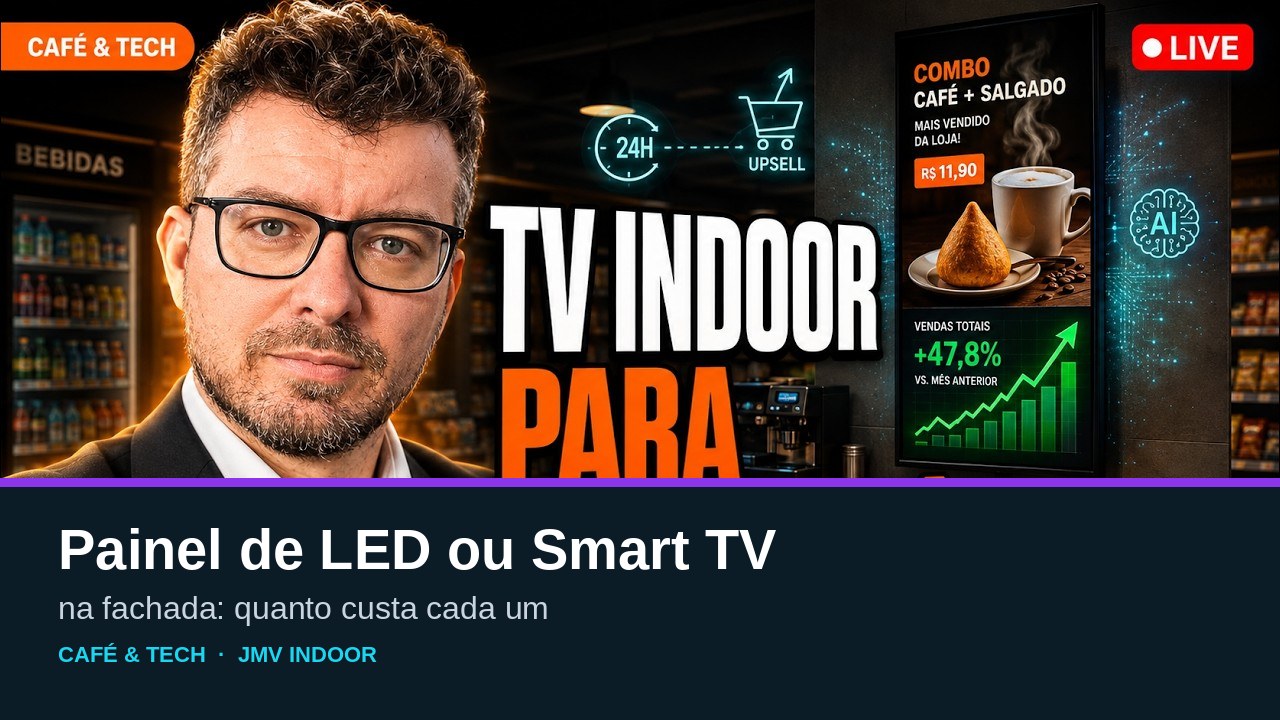
An LED wall is a screen assembled from modular cabinets of light points and sold by the square metre. In public supplier listings from August 2026, a 3×2 m outdoor wall was listed at around R$ 36,810 (Techlumens, P3.9) and R$ 36,750 (a 12-cabinet kit on Mercado Livre) — with no structure, installation or electrical design, all billed separately. An 85-inch smart TV runs between R$ 7,000 and R$ 10,000, and a 98-inch between R$ 12,000 and R$ 17,000, with cloud content management on an affordable subscription (check the current price list). The decisive difference, though, is not the purchase price: it is who changes the content — on an LED wall that usually means the manufacturer's software and someone physically on site; on a cloud-managed TV, the piece goes up from a phone and is live in minutes.
What an LED wall costs
The price is not per "screen", it is per square metre — and what drives that figure is the pixel pitch, the distance in millimetres between two neighbouring light points. P3 means 3 mm between points; P10, ten. The finer the pitch, the more points per square metre, the sharper the image and the higher the price. Add whether the wall is outdoor (sealed, high brightness) or indoor and you have almost the whole pricing structure.
The most searched size on the market is 3×2 metres: 6 m² of screen, assembled from modular cabinets — 24 units of 500×500 mm or a 12-piece kit of 960×960 mm. These are the figures we found in public supplier listings checked in August 2026:
| Source (August 2026) | 3×2 m wall | What is included |
|---|---|---|
| Techlumens — P3.9 outdoor | R$ 36,810 | Equipment only. No structure, installation or electrical design. |
| Mercado Livre — 12-cabinet kit | R$ 36,750 | Equipment only. No structure, installation or electrical design. |
| Range across the listing cluster observed | R$ 15,000 to R$ 48,800 | From a used P10 outdoor unit (floor) to a new P2.5 indoor one (ceiling). |
Two traps when researching prices: indoor LED wall, in this market's vocabulary, means a wall for interior environments (fine pitch) and has nothing to do with Indoor TV in the sense of retail media; and a good share of what shows up as "LED panel" in price searches is a recessed light fitting costing R$ 155 to R$ 339 — a different product entirely. If the price looks too good, check that you are looking at a video screen.
What the alternative costs: smart TV plus cloud management
On the other side, the account has four lines: the TV, the mount, the electrical and network install, and the monthly fee for the platform that controls what appears on screen. Market reference values for August 2026, which vary by region, model and payment terms:
- 75": R$ 4,000 to R$ 8,000.
- 85": R$ 7,000 to R$ 10,000 — a TCL 85" QLED, for instance, was listed at R$ 7,285.
- 98": R$ 12,000 to R$ 17,000 — a Samsung 98" at R$ 12,284 and an LG 98" at R$ 16,999 in the listings we checked.
- Heavy-duty wall mount: around R$ 500 for large screens.
- Power and network point: R$ 500 to R$ 1,000, depending on the distance to the router.
- JMV Indoor platform: Start and Pro plans, with prices always up to date. Always confirm the current price list; the full comparison, trial period included, is in the free trial and fast setup guide.
You do not need to buy a computer, box or separate player: the display app runs on the TV itself, as we explain in which smart TVs run the app and in Indoor TV without extra hardware. The network is the silent requirement: a weak signal freezes playback, and the requirements are in Indoor TV freezing: network requirements.
Table: total cost in year one
This is the comparison that matters — not the screen price on its own, but what leaves the till in the first twelve months of a first installation, in one store:
| Cost line | 3×2 outdoor LED wall | 85" smart TV + JMV Indoor |
|---|---|---|
| Equipment | R$ 36,750 to R$ 36,810 (August 2026 listing) | R$ 7,000 to R$ 10,000 |
| Structure, mounting and installation | Not included in the listing. Ask for a turnkey quote | Mount ~R$ 500 |
| Power and network | Dedicated electrical design and switchboard (varies by job) | R$ 500 to R$ 1,000 |
| Software / content management | Manufacturer's proprietary software, licensed per project — no standard public price | monthly subscription, no lock-in — see current pricing |
| Cost of keeping the screen current | Travel and physical presence for each change, in most projects | No travel: the piece goes up from a phone |
| Order of magnitude in year one | R$ 37k (wall only), plus structure and installation | R$ 8.6k to R$ 12.1k |
The difference is several times over, not a few per cent. And it is not explained by quality: it is explained by purpose. An LED wall is built to be read from far away and under sun; a smart TV is built to be watched up close and under controlled light. If your screen fits the second case — and most retail screens do — you are paying several times over for a requirement you do not have.
The invisible cost: uploading content
Here is the part most comparisons leave out of the spreadsheet: what it costs to keep the screen up to date. They frame the decision as a hardware purchase. In a real operation it is the opposite: you pay for the hardware once, and you pay for the updates every week.
On an LED wall, the piece has to be built at that wall's exact resolution and format, exported through the manufacturer's proprietary software and sent to the controller. In many projects that happens over a cable, on site — meaning someone has to be there. Ordinary video, straight off a phone, usually will not play as is; it is fair to say, though, that newer walls do accept remote upload and more forgiving formats, so confirm this with the manufacturer instead of treating it as an absolute rule.
On a cloud-managed TV, the same change is a counter routine: a photo of the product on a phone, the photo turned into a captioned video with no editor and no agency, and the piece lands in the right playlist within minutes — including when it is done by whoever is in the store, as we show in managing Indoor TV from your phone. That difference decides whether, in month three, the screen still shows the right price — or whether it becomes an idle investment showing an expired promotion.
Where the LED wall genuinely wins
This article is not a sales pitch, so here is the honest part: under direct sunlight, an LED wall delivers brightness a regular smart TV cannot match. That is the first objection any specialist raises, and it is correct. The numbers, with manufacturer sources:
- Outdoor facade LED wall: works in the 4,500 to 5,000 nit range, with IP65 sealing against rain and dust.
- Professional window displays: the Samsung OM75R is rated at 4,000 nits; the LG 75XS2E-B at 2,500 nits, with 24/7 operation and a stated life of 50,000 hours.
- Typical consumer smart TV: sits far below those figures — which is why it performs well behind the window, in shade or indirect light, and badly when pointed at the afternoon sun.
The nit (candela per square metre) is precisely the unit of this argument: how much light the screen emits per unit of area. Beyond brightness, the LED wall wins on two more counts: huge, non-standard formats — a 6×1 m ribbon, a screen that follows the architecture of the facade, something no TV does — and durability engineered for continuous outdoor use. If that is your case, then that is your case: buy the wall, and treat the content operation as part of the project rather than as a detail.
Where the smart TV wins
- Cost. Several times lower, payable in instalments and with no building work.
- Sharpness at short and medium range. A three-year-old phone already shoots in 4K, and on an 85" or 98" screen — including in portrait — that beats a coarse-pitch wall built to be seen from afar.
- Remote updates. Changing the message depends on nobody travelling to the site and on nobody knowing the manufacturer's software.
- The asset is yours and it is liquid. A TV can be resold or reused: it becomes a meeting-room screen, an interior display, a training screen. An LED wall is capital locked into that function and that facade.
- No vendor dependency to publish. You do not open a support ticket to put tomorrow's promotion on screen.
Decision checklist
Six questions settle the choice without needing a consultant:
- From how far will the screen be read? From the pavement or inside the store → TV. From the avenue, tens of metres away → LED wall.
- Does direct sun hit the screen? Hours of direct sun → LED wall or high-brightness display. Shade, indirect light or behind the window → TV.
- How often does the content change? Weekly or more → cloud management, no debate. Once a quarter → the manufacturer's software hurts less.
- Who will change the content? If the answer is "someone in the store, from their phone", the decision is already made.
- What is the budget available today? If R$ 37,000 of equipment plus building work does not fit, the R$ 8,000–12,000 first-year alternative is not a consolation prize — it is the right call for most cases.
- One screen or several? Multiple points favour the cloud, thanks to the additional-point price and central control across all units.
How to mount an outdoor-facing TV properly
If you chose the TV facing the street, it has to be installed as facade equipment, not as a living-room TV:
- Behind the shop window wherever possible, with the glass doing the protecting.
- Brightness matched to the spot — measure the sun at the critical hour before choosing the model; in a strongly lit window, use a high-brightness display, not a consumer TV.
- Back protected from rain and splashes, with the electrical connections in a sheltered enclosure.
- A network cable to the router, preferably, instead of relying on the store's Wi-Fi.
- Ventilation: a large screen in a closed window gets far hotter than on a living-room wall.
- Local facade rules: advertising and visual communication on shopfronts tend to have city-specific rules — check with your council before installing.
The gas station case
Forecourts are where this question comes up most, and for good reason: the price totem is already the most-watched point of the facade — everyone driving past looks at it. A screen beside it, or in the c-store window facing the pumps, borrows a glance that already happens, without having to earn it from scratch.
What to show in each daypart, where the four screen positions of a station with a c-store are, and how to build the playlist around refuelling time is covered in the sibling article: Indoor TV for gas stations and convenience stores. For the category beyond the product, the digital signage entry on Wikipedia gives an overview of formats and market.
Excerpts from the episode behind this article (transcript)
Quotes from the episode Indoor TV for convenience stores: turning your TV into a 24/7 salesperson (Café & Tech, August 20, 2026, 1h11m39s), with Mário Sérgio and Josimar Machado, translated from Portuguese:
"How much does one of those walls cost? Tens or hundreds of thousands of reais. […] Now, with an Indoor TV system, you have a cheap system — R$ 8,000 next to a wall like that is free."
"Does a 3x2 P3 wall cost more than 30k?" — a live-chat comment from a viewer, confirmed off the cuff during the episode. The supplier listings checked in August 2026 support the figure.
"To upload content to an LED wall you need the manufacturer's software. You don't just take your video and drop it in there."
"There are newer walls that adapt" — the episode's own caveat, and the reason this article does not treat the limitation as an absolute rule.
"Your three-year-old phone already shoots in 4K. On a big TV, in portrait, that looks better than on a coarse-pitch wall."
The full episode, in Portuguese, is on JMV's YouTube channel.
JMV Indoor runs on an ordinary smart TV, managed from your browser, with an accessible entry plan (confirm the current price on the plans page). For installation questions, reach the team through the contact form or on WhatsApp at +55 (11) 4063-8923. JMV Technology serves more than 10,000 customers in 18 countries and has been running since 2003. This article covers one slice of a 1h11 episode — watch the full Café & Tech episode on YouTube.
In short: an LED wall is the right equipment for direct sun, long viewing distances and non-standard formats — and it charges you a construction budget, not a purchase price. For the rest of retail, a well-placed large screen with cloud scheduling delivers the same commercial result for a fraction of the cost, and wins on the line nobody budgets for: tomorrow's message goes up today, from a phone, with nobody travelling to the store. On how data is handled on your side and ours, see our Privacy Policy.