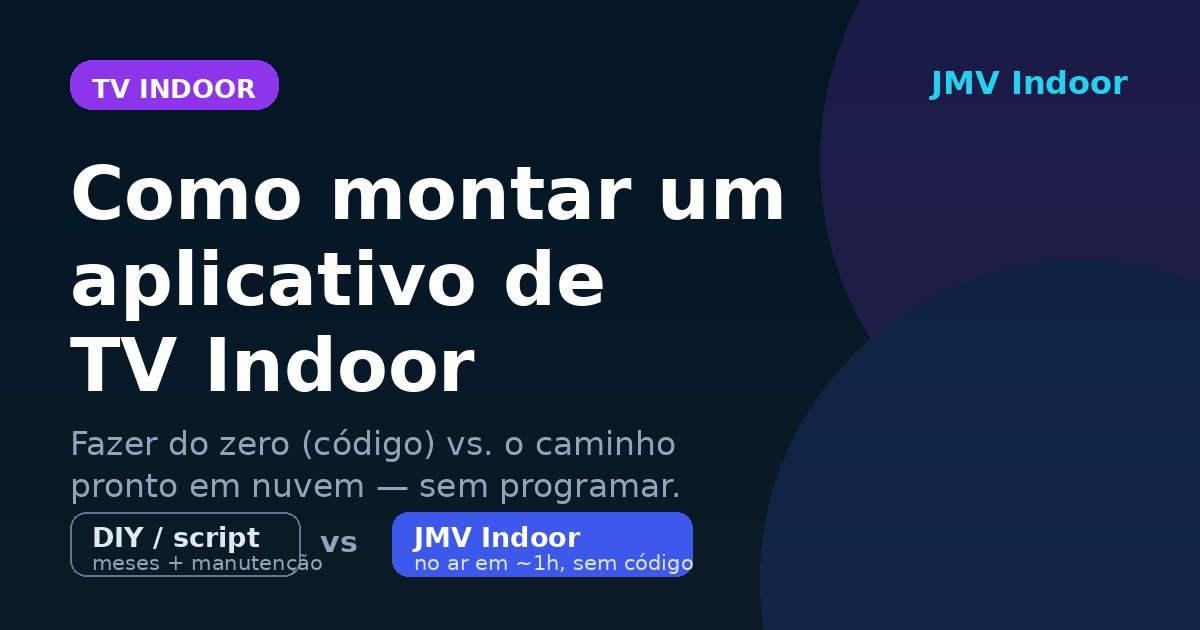
Building an indoor TV app means bringing together the components that display and manage content on a screen inside a business: a player that runs on the TV, a panel to build and schedule the playlist, storage, remote updates and uptime monitoring. There are two routes: develop everything from scratch (your own code + hardware), which usually takes months and requires ongoing maintenance, or use a ready-made cloud platform like JMV Indoor — no coding, no local server, with the channel live in minutes.
What an "indoor TV app" is and what it needs
Indoor TV is digital signage applied to the point of sale: screens inside stores, receptions, pharmacies, gyms and restaurants showing offers, notices and brand content. The "app" is the piece that plays that content on the screen — but on its own it is not enough. Reliable indoor TV is the sum of several components:
- Player — the app that runs on the TV and loops the media, ideally with local cache so it does not freeze when the network fluctuates.
- Management panel (CMS) — where you build the playlist, set the order and schedule by time.
- Storage — where the videos and images live, with bandwidth to deliver them to the screens.
- Remote updates — swap content without going to the store, ideally from your phone.
- Multiple screens — control several locations and send different playlists to each one.
- Uptime monitoring — know whether each screen is live and playing.
Keep this list: it is the yardstick for any route. If a solution delivers only the player and leaves you to solve the panel, storage and monitoring on your own, the work (and the cost) has simply moved elsewhere.
Route 1 — building from scratch (DIY / script)
This is the route for those who want full control and have a technical team. Building from scratch usually means developing a native app (for example, for Android TV, Roku or Tizen) with API syncing and local cache, plus building the web panel, paying for storage and handling the screen hardware. In short, you become a small digital signage software shop.
The components and the real cost look like this:
| Component | What it requires | Cost/maintenance often forgotten |
|---|---|---|
| Native player app | Development per platform (Android TV, Roku, Tizen…) | Updates with every TV system change; publishing and review in the app stores. |
| Panel / CMS | Management site for playlist and scheduling | User accounts, permissions, backups, ongoing fixes. |
| Storage + delivery | Server/cloud for the videos | Bandwidth, cost per GB and reliable syncing to the screen. |
| Uptime / monitoring | Knowing whether each screen is live | Alerts and support when a screen goes down after hours. |
| Hardware | TVs, and sometimes a box/mini-PC per screen | Equipment replacement, warranty, power on all day. |
There is no single price, but the pattern is clear: the real spend is not the "first working app" but the permanent maintenance. It makes sense for those with a very specific need and a team to sustain it for years. For most stores, it is effort outside the core of the business.
Does an "indoor TV script" exist? What the search really wants
A common search is for an "indoor TV script" — the expectation of a ready file that solves everything. Here honesty matters: a standalone script, at best, covers one part (for example, looping a folder of videos). It does not provide the scheduling panel, cloud storage, remote updates or monitoring. In other words, "downloading a script" is not building manageable indoor TV — it is building a fragile video player, with no remote control and no way to know whether the screen is live.
Route 2 — ready-made cloud platform (5 steps)
The ready-made route delivers all of those components as a service. At JMV Indoor, the real activation flow — described on the product page itself as "from subscription to your indoor TV live, all in a few minutes, 100% in the cloud, with no external equipment" — has five steps, none of them with code:
- Plan — you choose and subscribe to a plan (or start the free trial).
- Access — you receive access to your account.
- Dashboard — you organize your videos "quickly and intuitively" in the panel.
- Upload — you send the media and build the playlist.
- App — you download JMV Indoor from your Smart TV's official store, find your channel and the screen goes live.
There is no programming step in any of the five, and the "hardware" is just the Smart TV you already have — the JMV Indoor app runs on it with no mandatory box. Once live, you manage the playlist from your phone, updating the schedule in real time from anywhere. And because the player runs right on the TV, compatibility covers the main Smart TVs on the market (Roku, Fire TV, Android TV, Samsung, LG, Apple TV and Chromecast).
Note how it fits two points that DIY builders usually struggle with: you get indoor TV with no extra device when the TV is already smart, and you can set up a vertical screen without a kiosk, standing in the window, with no dedicated hardware.
DIY vs. ready-made: an honest comparison
Neither route is "better" in absolute terms — it depends on your context. The fair comparison is this:
| Criterion | Building from scratch (DIY) | Ready-made platform (JMV Indoor) |
|---|---|---|
| Needs coding | Yes (app + panel + integration) | No |
| Time to first screen live | Weeks to months | Minutes |
| Maintenance | Yours, ongoing and permanent | The platform's (included) |
| Panel, scheduling and monitoring | You build it | Already included |
| Hardware | TVs + possible box per screen | The Smart TV you already have |
| Cost | High and variable (dev + infra + support) | Predictable subscription |
| Best for | Those with a technical team and a bespoke need | Stores that want the screen working, not software to maintain |
In short: DIY delivers maximum customization in exchange for time and maintenance; the ready-made platform delivers predictability and speed in exchange for less low-level control. For most businesses, getting the store's communication live fast and without maintaining software wins.
How to start today
If you want to test the fastest route before deciding, the plan is simple: start the 30-day free trial, upload your videos in the dashboard, build the playlist and download JMV Indoor from your Smart TV's store. In a few minutes the screen is showing your channel — no installer, no construction work and not a single line of code. The details of each plan are on the JMV Indoor plans page.
Questions about your screen? Talk to us through the contact form.