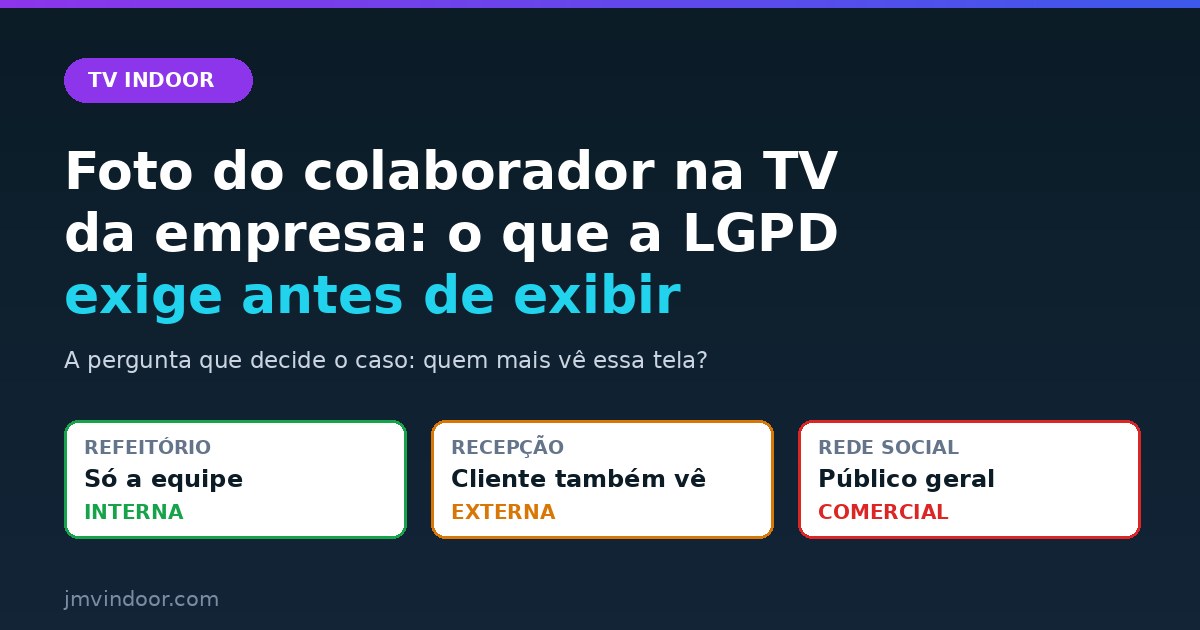
An employee's photo, name and date of birth are personal data, and showing them on a screen is processing (Law 13,709/2018, article 5, items I and X). Two lawful bases hold up: specific consent in a document separate from the employment contract, or legitimate interest documented with a right to object (article 7, items I and IX). The LGPD does not require written authorisation — article 8 allows “in writing or by another means that demonstrates the declaration of will”; writing is recommended because the burden of proof sits with the company. In practice this turns into three operational duties: refusing has to be possible without embarrassment, the piece has to leave the screen the same day someone withdraws consent, and the playlist needs an expiry date. For birthdays, collect day and month, never the year. And before all of that, answer this: who else sees that screen?
The advice everyone gives and nobody qualifies
In the Café & Tech episode on indoor TV for HR, the suggestion arrives with enthusiasm: make a piece with your employee's photo, this is the person who stood out this month, and run it on every screen in the plant that week. And also: in a factory, how many people share a birthday? You can make a nice little video for each one.
It is a good internal communication idea, and it works.
The catch is that the conversation ends there. Not a word about lawful basis, authorisation, or what to do when somebody would rather not appear.
And this is not an oversight by the podcast. On September 19, 2026 we asked Google, through its AI Overview, what to display on a factory floor information board. The answer tells HR to show “Birthdays of the Month/Week: photos of employees” and “Highlights and Recognition: photos of the operator of the month” — without a single line about the LGPD, lawful basis or authorisation. The recommendation is unanimous; the qualification is missing.
This article fills that gap. But without turning into yet another legal summary: the legal part fits in four sections, and the part nobody writes — how any of this is actually complied with in a playlist looping across 40 screens — is the longest one.
What exactly counts as personal data here
The birthday board has been on the break room wall for thirty years. What changed is not the tribute, it is the status of the information.
Brazil's LGPD, Law 13,709/2018, defines personal data as information relating to an identified or identifiable natural person (article 5, item I). That captures, all at once: the photo, the name, the job title, the date of birth, years of service, the site where the person works. And item X defines processing broadly — it expressly includes use, communication, transmission, distribution and dissemination. Displaying on a screen is processing, no argument.
In other words: the subject is serious, but it falls under the ordinary LGPD regime, not the heightened regime for sensitive data. The only question to answer is which lawful basis supports the display.
Why an employee's consent is fragile
It starts with an exclusion that saves time. The “performance of a contract” basis (article 7, item V) does not apply here, and the statutory wording is explicit: it refers to a contract “to which the data subject is a party, at the data subject's request”. Putting someone's photo on the birthday board is not necessary to perform an employment contract, and nobody was hired having asked for it.
That leaves consent — and here is the problem everyone senses. Article 5, item XII requires a “free, informed and unambiguous” declaration. Inside a relationship of subordination, “free” is exactly what becomes hard to prove. Does someone who signs because the manager asked, or because they do not want to look like the difficult one, sign freely?
A precision is worth making, because many texts overshoot: subordination does not invalidate an employee's consent. It makes it harder to prove the consent was free — and article 8, paragraph 2 places that burden of proof on the company. It is not a prohibition; it is an evidentiary load the company takes on.
There is a counterpoint that rarely reaches the first page of search results and that should be reassuring: in data protection scholarship, the birthday board is one of the classic examples of valid consent. Not by accident — it is optional by nature. HR invites whoever wants to take part to send a photo, and whoever does not send one suffers no consequence. Consent is problematic when it is used to legitimise something the worker cannot refuse, such as monitoring. In an optional tribute, it works well.
The practical lesson is this: what saves consent is genuine optionality. If saying no costs something, the consent is worthless. If saying no costs nothing, it holds.
The two lawful bases
There are two defensible routes, and choosing between them is not cosmetic — it changes what the company has to document and what it has to offer the employee.
| Route A — Consent | Route B — Legitimate interest | |
|---|---|---|
| Lawful basis | Article 7, item I | Article 7, item IX + article 10 |
| How the employee joins | Opt-in: only those who authorised appear | Opt-out: whoever has not objected appears |
| What the company must hold | Separate form, with a specific purpose and a period | Documented balancing test + advance notice + objection channel |
| Weak point | Proving it was free (company's burden, article 8, paragraph 2) | Proving the company's interest does not override the subject's rights |
| Best fit | Individual tributes: birthdays, employee of the month, years of service | Broader institutional communication, team photos, internal event coverage |
Route B is often presented as the shortcut that skips signatures. It is not quite that. Article 10 limits legitimate interest to “legitimate purposes, considered from concrete situations”, and item I is literally “support and promotion of the controller's activities” — the provision that underpins internal marketing. But it comes with three constraints in the same article: only data “strictly necessary for the intended purpose” (paragraph 1), mandatory transparency (paragraph 2), and the possibility of the national authority requiring a data protection impact report (paragraph 3).
Paragraph 1, incidentally, is the exact legal ground for that seemingly minor recommendation: collect the day and month, never the year. Nobody's age is strictly necessary to wish them a happy birthday on a screen.
And there is a warning straight from the authority itself. In the ANPD Legitimate Interest Guide, the balancing test is structured in three phases — purpose, necessity, and balancing and safeguards. In example 7 of the guide, dealing with software that tracks employee activity, the ANPD rejects legitimate interest. And it records the sentence any HR team should read before choosing Route B: in the context of the employment relationship, employees are in a position of greater vulnerability in relation to their employer, lacking effective means of objecting to the processing.
The release form that actually works
Before the template, a point most texts get wrong. You often read that “the LGPD requires written authorisation”. It does not. Article 8 says consent “must be given in writing or by another means that demonstrates the declaration of will of the data subject”. An internal form, an acceptance in the HR system or a recorded reply all qualify. Writing is recommended for a practical reason, not a formal one: the company is the one that has to prove it (paragraph 2).
That said, a release that holds up has five features:
- Separate from the employment contract. That onboarding clause authorising use of the image “in any and all promotional material, internal or external” is the textbook example of what article 8, paragraph 4 calls a blanket authorisation — and declares null.
- A specific purpose. Not “company communications”, but “display on internal screens at site X, in birthday and recognition campaigns”. If the photo later goes to Instagram, that is a different purpose and a new request.
- A time limit. A month, a quarter, the life of the contract — whatever makes sense. But with a date, because the alternative is displaying it forever.
- Easy withdrawal. The law asks for a “free and simplified” procedure (paragraph 5). State in the form itself who the person should talk to and how quickly the piece comes off the air.
- No consequence for refusing, said out loud. It is not enough for it to be true: it has to be written down, because that is what supports the word “free” in article 5, item XII.
There is also a layer that is not the LGPD and survives alongside it: the right to one's image. It comes from the Constitution (article 5, item X, which makes image inviolable and guarantees compensation; and item LXXIX, which since Amendment 115/2022 places data protection among fundamental rights), from the Civil Code (article 11 on personality rights; article 18, which forbids using someone's name in commercial advertising without authorisation; and article 20, which allows the display of an image to be barred when it harms honour or is intended for commercial purposes) and from the Labour Code itself, whose article 223-C lists image among a worker's legally protected assets. They are two parallel tracks: complying with the LGPD does not remove the need for an image release once the use becomes external or commercial.
The half nobody writes: how this works on the screen
Here is the difference between having a neat form in a drawer and delivering what it promises. Every item below is a legal duty that only becomes real in the operation of the playlist.
1. Withdrawal in minutes, not in site visits
The law speaks of a “free and simplified” withdrawal procedure (article 8, paragraph 5). Translated into the reality of someone running 40 screens across three sites: when a person asks to be removed, the piece has to disappear from all of them the same day, without anyone driving around with a USB stick.
That is why local media models do not pair well with content featuring people. In cloud based systems — JMV Indoor among them — the piece leaves the playlist from the dashboard or from a phone and the change reaches the connected screens. This stopped being an operational convenience and became a compliance requirement the moment the company signed a form promising simplified removal.
2. Scheduled expiry, not somebody's memory
March's tribute cannot still be running in June. Except nobody remembers to remove last month's employee of the month — it is the task that always loses to the urgency of the day.
The fix is not discipline, it is scheduling: set the end date at the moment you publish, not afterwards. It applies to the birthday piece (off at the end of the day or the week), to the employee of the month (off at month end) and to the induction video for a new joiner. Our article on scheduling indoor TV by time of day shows how this works inside a daily programme.
3. Who publishes — the access question
Not everyone who touches the TV should be able to upload a person's photo. A price piece and a safety notice are one thing; an employee's image is another, because it involves a data subject with rights.
In practice that means deciding and writing down who holds the credential that publishes content featuring people, who reviews before it airs, and who receives withdrawal requests. It is an internal organisation decision, and it is worth asking your screen provider what access controls it offers — the features vary from platform to platform, and JMV Indoor does not publicly document a role matrix. What must not happen is the dashboard password circulating in the team's WhatsApp group.
4. The file afterwards — the problem that outlives the screen
You took the piece off the air. Where is the file?
On the phone of whoever filmed it. In the team group chat. In the marketing folder. On the camera card. A withdrawal that only clears the playlist is half a withdrawal — and it is the half nobody documents. Define where material featuring people is stored, for how long, and what happens to it when the authorisation ends.
5. A living opt-in list
The list is not a document, it is a process. It needs:
- Entry: new joiners are invited to take part, with the refusal offered in the same sentence as the invitation.
- Review: once a year, or whenever the purpose changes. Someone who authorised the break room screen did not authorise Instagram.
- Exit: termination removes the person from the list and from the air, on the same checklist as the badge (see the section on the employee who has left).
- Record: keeping what, when and on what basis — that record is what answers the question in article 8, paragraph 2.
⭐ The question that changes everything: who else sees that screen?
This is the section that separates this article from any generic legal text — and it grows out of a banal question that is almost never asked: where is the screen hanging?
Honouring Maria in the break room is not the same as making Maria the face of the brand on the shop floor screen. The wording of the tribute can be identical. The legal framing is not.
| Where the screen is | Who sees it | How to treat it |
|---|---|---|
| Break room, locker room, internal corridor, factory floor | Staff only | Internal communication: defined lawful basis (Route A or B) + recorded opt-in |
| Reception, shop floor, waiting area, window display | Staff and public | External publication: express image release, on top of the LGPD basis |
| Social media, website, advertising campaign | General public | Commercial use of the image: strictest rule, specific and possibly paid authorisation |
Why does the second row change regime? Because the moment a customer sees the screen, the employee's image has stopped circulating internally. The Civil Code, in article 20, allows the display of an image to be barred when it harms honour or when it is intended for commercial purposes — and a shop screen exists to sell. Add Precedent 403 of Brazil's Superior Court of Justice, whose wording is blunt: compensation for the unauthorised publication of a person's image for economic or commercial purposes does not depend on proof of loss. The person exposed does not have to demonstrate harm.
In retail, this is the rule and not the exception. The shop screen is seen by people who buy. If your chain intends to honour staff on sales floor screens, that is a case for an express image release, not mere internal communication. It is cheap to respect beforehand and expensive to fix afterwards.
The mirror situation helps make it stick: when the data subject is a customer rather than an employee, the analysis shifts again — there is no subordination, and the person freely chooses to appear. We covered that case in happy birthday on the restaurant TV: who authorises the photo. It is worth reading the two side by side: what changes is not the screen, it is who is in the photo and what relationship that person has with whoever publishes it.
Honouring people without a photo
There is an exit almost nobody offers, and it solves the problem at the root: honour people without a portrait.
- Name only — “Happy birthday, Maria!” is still a tribute, and the data set on display shrinks considerably.
- By team or shift — “This week's birthdays in Dispatch”, with the names listed.
- By achievement, not by face — “Shift B: 90 days without an accident” recognises without exposing anyone individually.
- Years of service — “Today João completes 10 years with us”, with an illustration instead of a photo.
And it is worth remembering why this matters: not everyone wants to appear, and the reasons are usually serious — religious belief, cultural background, personal safety, a domestic violence situation in which appearing on a public screen is a concrete risk. Nobody should have to explain that to HR in order to exercise a refusal. If the operation supports both the photo and the photo-free format, refusing genuinely costs nothing — and then the lawful basis, whichever route you took, becomes far more solid.
If the goal is to fill the screen with team content without entering this discussion at all, there is plenty of material that involves no one's image: procedures, targets, safety notices, short training. See how to use idle screen time to engage the team and what to put on the TV for onboarding new joiners.
The employee who has left
The authorisation lasts as long as the employment relationship. After that, it does not.
On March 2, 2026, the Regional Labour Court of the 3rd Region (Minas Gerais) published a ruling by its Eleventh Panel, reported by Judge Marcelo Lamego Pertence, ordering two car dealerships to pay R$ 10,000 in moral damages to a former employee. The reason: promotional videos featuring her image and voice stayed up on the companies' social media after termination. There was a contractual clause authorising use of the image “in any and all promotional material, internal or external” — and the court held that such authorisation does not extend beyond the life of the employment relationship (case PJe 0010702-39.2023.5.03.0018).
Two details of that case deserve the attention of anyone running screens. First: the evidence was a video showing the recordings were still published ten days after dismissal. Ten days. Second: the broad onboarding clause, far from protecting the company, is exactly the kind of authorisation the LGPD treats as blanket.
The case involved social media advertising, not a break room screen — the difference matters and should not be blurred. But the principle applied is the one that counts here: an image licence follows the life of the contract. So removing pieces featuring someone's image belongs on the offboarding checklist, next to the badge, the email account and system access. With cloud scheduling that takes minutes — provided somebody has the task written down. Our article on managing indoor TV from your phone covers the practical side of pulling content off the air wherever you are.
An operational summary, in seven lines
- Answer this first: who else sees that screen? Customers watching means external publication, a different level of authorisation.
- Pick the route: separate consent (opt-in) or documented legitimate interest (opt-out with a real objection channel).
- No blanket clause in the employment contract — separate document, narrow purpose, time limit.
- Birthdays: day and month, never the year.
- Every piece featuring a person is published with a scheduled end date.
- Withdrawal: a known path, piece off the air the same day, across every site.
- Termination takes the image off the air — and the file out of circulation too.
Do that, and the podcast's advice goes back to being what it is: a good internal communication idea. The tribute is not the problem. The problem is a tribute with no agreement and no exit button.
Frequently asked questions
The first four questions came from Google's “people also ask” box for employee photo on company TV LGPD, measured on 19/09/2026. The rest are the operational questions the first page of results does not answer.
What does the LGPD say about photos?
Can a company use an employee's image?
Is it allowed to take photos of employees?
What does the LGPD say about image release forms?
Can the employee's release be a clause in the employment contract?
Can an employee refuse to appear on the company TV?
How do you pull an employee's photo from every screen after they withdraw consent?
Can I show only the birthday person's name, without a photo?
Do I have to remove the image of someone who has left the company?
Disclaimer. This text is informational and does not constitute legal advice. Your release template, your choice of lawful basis and your balancing test should be validated with your legal team and your data protection officer, who know your operation, your collective agreements and your sector.
This article grew out of the episode Indoor TV for HR: real-time internal communication for the whole company, from the Café & Tech Podcast, published on April 15, 2026.